TLDR;
The video analyses China's Type 076 amphibious assault ship, dispelling the myth that it's a groundbreaking unmanned aircraft carrier. Instead, it's a hybrid ship reflecting China's pragmatic approach to naval development, addressing gaps in propulsion, aircraft systems, and carrier design. The ship's design choices, such as helicopter landing spots and electromagnetic catapults, reveal its multi-functional role, combining amphibious assault capabilities with UAV operations.
- The Type 076 is not a fully unmanned aircraft carrier but a hybrid amphibious assault ship.
- It addresses limitations in China's naval capabilities and compensates for design flaws in existing carriers.
- The ship's design reflects a pragmatic approach, balancing technological limitations with strategic needs.
Introduction: The Mist of Changing Islands and the Misunderstood Beast [0:00]
The video introduces China's Type 076 amphibious assault ship, which began its first sea trial on December 2nd, 2025. Despite initial speculation, high-definition images reveal that it is not a fully unmanned aircraft carrier. Instead, it is a hybrid amphibious assault ship, showcasing China's practical approach to naval advancement. The Type 076 addresses existing shortcomings in China's naval power, particularly in propulsion technology, aircraft systems, and carrier design.
Deck Symbols: The Eight Triangles Dispel the UAV Myth [0:48]
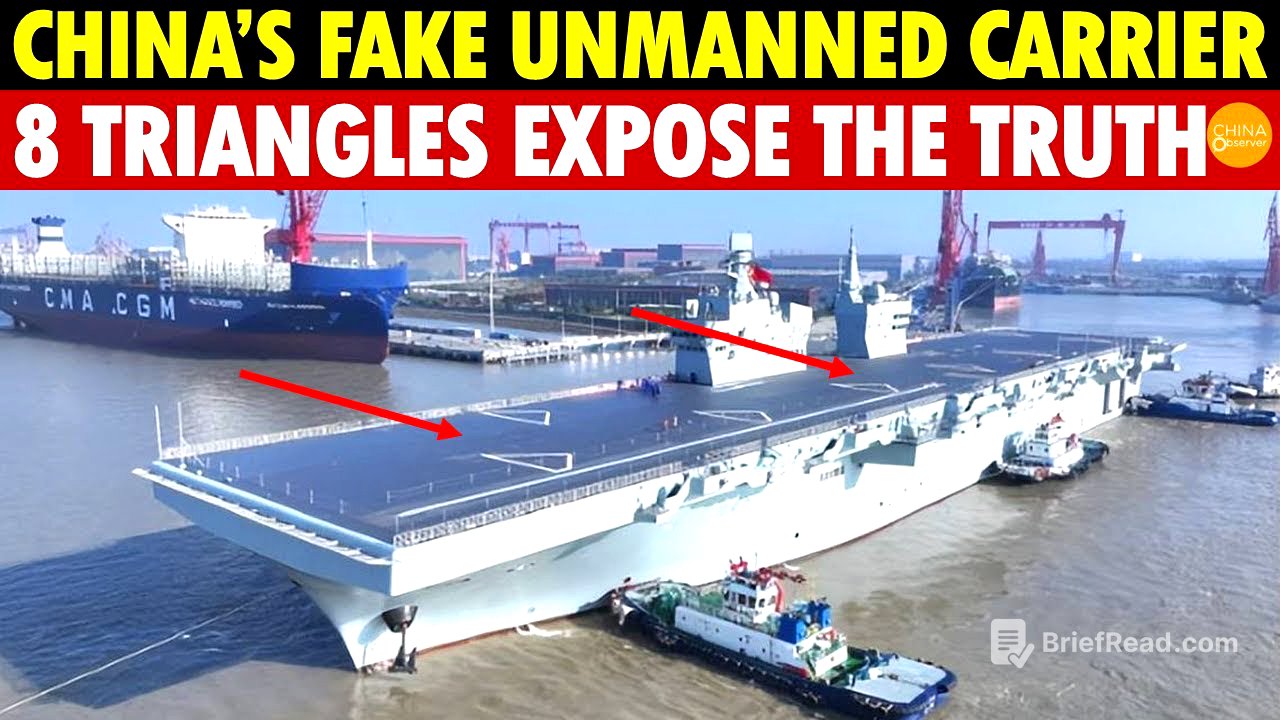
The presence of eight large white triangle symbols on the Type 076's deck indicates its continued role as an amphibious assault ship. These symbols are identical to those found on existing Type 075 ships and serve as optical landing aids for helicopters like the Z8, Z20, and future Z21. The significant space occupied by these helicopter landing points suggests that the Type 076's primary mission remains vertical envelopment using helicopters and anti-submarine warfare, rather than solely focusing on UAV operations.
Turkeykey's Lesson: From Desperate Measure to Poor Men's Aircraft Carrier [2:38]
The Turkish Navy's TCG Anadolu, which has conducted large-scale UAV tests, illustrates the limitations of unmanned aircraft carriers. Turkey was forced to adopt UAVs after being removed from the F-35 programme, highlighting that UAVs cannot fully replace manned aircraft. The TB3 UAV, while suitable for low-intensity missions, struggles against conventional navies with air defence capabilities. Turkey's plans to equip future carriers with jet trainers further emphasise that UAVs serve as a cost-effective supplement, not a complete substitute.
The True Combat Power of the Attack 21 Sword or Scout [4:42]
China has progressed beyond propeller-driven drones, equipping the Type 076 with electromagnetic catapults for more advanced UAVs like the Attack 21. The Attack 21, a 10-ton flying wing stealth UAV, is comparable to the US Navy's X47B or MQ25 Stingray. However, its smaller size limits its payload and range, making it unsuitable for carrying large anti-ship missiles. Its aerodynamic design prioritises stealth over maneuverability, making it better suited for reconnaissance and surveillance than combat.
The Weakness of Early Warning Aircraft: Why the KJ600 Can't Do It All [7:06]
Early warning aircraft like the KJ600 have limitations in modern naval warfare. While the KJ600 has powerful radar, it cannot get too close to the enemy and has limited identification capabilities. The Attack 21 UAV addresses these weaknesses with its stealth capabilities and advanced sensors, allowing it to collect radar frequencies, identify ship types, and pinpoint coordinates. This combination of the Type 076 and Attack 21 aims to fill a missing strike chain front in China's naval anti-access strategy.
The F-35B's Absence: The Fundamental Difference Between US and Chinese Amphibious Ships [9:25]
The hybrid design of the Type 076 stems from China's lack of vertical short takeoff and landing (STOVL) engines like the F-35B. The US Navy can easily convert amphibious assault ships into lightning carriers due to the F-35B's capabilities. China's Navy was forced to adapt by including an electromagnetic catapult on the amphibious assault ship, reflecting engineering pragmatism. This decision brings potential technical risks, particularly regarding the power system, necessitating upgrades to gas turbines or an integrated electric propulsion system (IEP).
The Hidden Pain of the Fujen: Is the 076 a Luxury Patch? [11:22]
The Type 076 serves a strategic purpose by addressing design flaws in the Type 003 Fujen carrier. The Fujen's third catapult interferes with landing, creating an efficiency bottleneck. The Type 076 can take over the launch and recovery of Attack 21 UAVs, acting as a "UAV nanny" to the Fujen. This division of labour maximises the operational efficiency of the entire carrier group, with the Fujen focusing on launching J35s and J15s, and the Type 076 handling Attack 21 UAVs and helicopters.
The True Roll: The Command Hub of Amphibious Landings [13:30]
The Type 076 redefines amphibious operations, especially when acting independently. It offers command and control capabilities far beyond the Type 075. The Attack 21 UAV leads the charge by suppressing air defence, disrupting the battlefield, and acting as an airborne Wi-Fi hotspot. This allows the Type 076 to serve as a powerful command hub for amphibious strike groups, providing landing forces with a comprehensive perspective of the battlefield.
The Invisible Challenge: The Logistical Nightmare of Hybrid Operations and Blockade Warfare Value [14:53]
The Type 076 faces operational complexity due to its simultaneous operation of hovercraft, helicopters, and UAVs, creating logistical challenges. Precise coordination is required to avoid accidents. However, if these hurdles are overcome, the Type 076's value in a Taiwan blockade scenario could surpass that of the Fujen. Its long-endurance UAVs can maintain airborne surveillance, identifying and hailing ships, making it a cost-effective tool for a sustained blockade.
Conclusion: The Dancer in Shackles [16:36]
The Type 076 represents a blend of limitations and pragmatic solutions. It addresses technical limitations, repairs system flaws, and integrates UAVs, helicopters, and amphibious capabilities to the fullest extent possible. The Type 076 is a "dancer in shackles," performing a unique role within its constraints. Its success will depend on future combat scenarios, but it signals China's realistic approach to naval development.