TLDR;
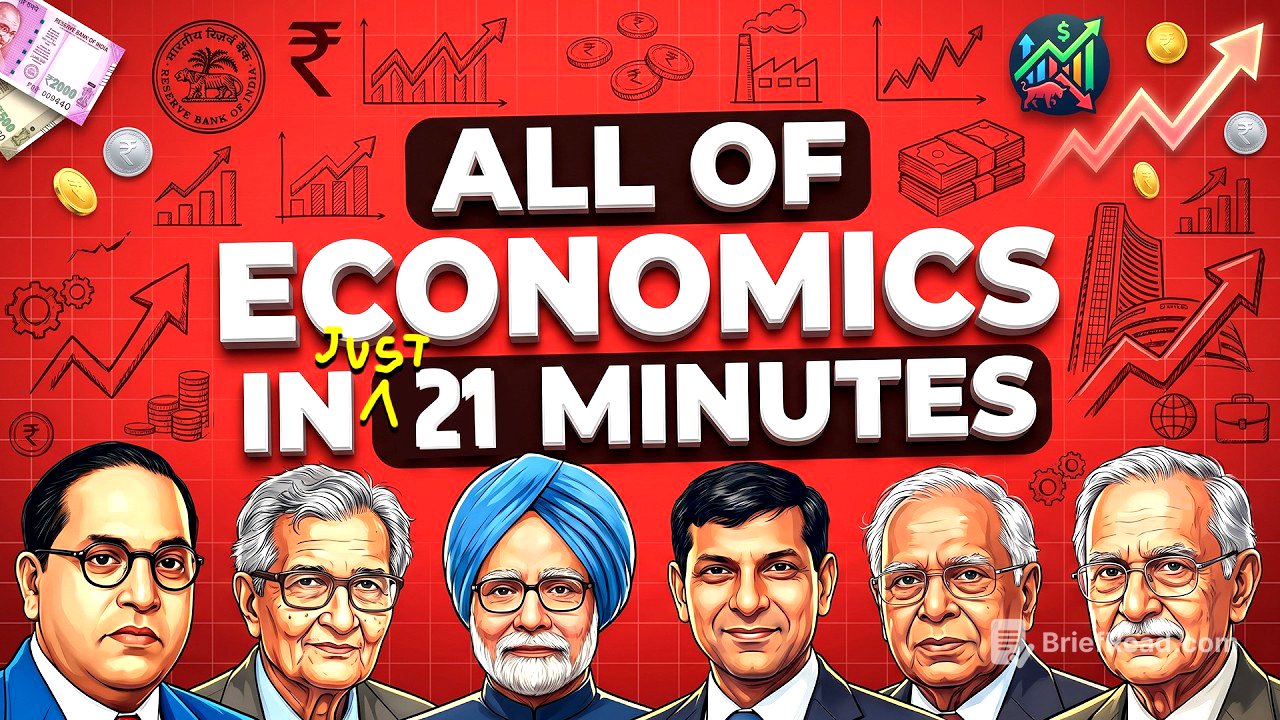
This video provides an understanding of economics and its relevance to everyday life. It highlights key concepts such as scarcity, opportunity cost, specialisation, comparative advantage, the importance of markets, and the role of banks. The video explains how demand and supply affect pricing, the challenges of inflation and deflation, and how monetary policy is managed by institutions like the Reserve Bank of India. Ultimately, it illustrates that economics is not just theoretical but a fundamental system guiding daily life decisions.
- Economics helps to understand human desires versus limited resources.
- Key principles include scarcity, opportunity cost, and specialisation in trade.
- Monetary policy affects inflation, purchasing power, and overall economic growth.
Understanding Economics [0:00]
The video begins by questioning the greatest suspense in the world, contrasting it with mundane issues like petrol price hikes and inflation. It defines economics as the science that studies how humans fulfil their unlimited desires with limited resources, introducing the concept of scarcity. Scarcity does not equate to poverty; it refers to the limited availability of resources affecting everyone, regardless of socio-economic status.
Scarcity and Choices [1:18]
It highlights that human desires are boundless, leading to the dilemma of choices where every decision involves a sacrifice. This leads to defining opportunity cost, where one must consider the value of the alternative option foregone when making a decision. Thus, economics encompasses more than just money—it also involves decision-making with associated costs.
Specialisation and Trade [3:21]
The video delves into specialisation, explaining how it allows individuals to focus on what they do best, thereby improving efficiency. This principle fosters trade, which is presented as one of humanity's most powerful inventions. The concept of comparative advantage is introduced, showing how individuals and societies benefit when they specialise and trade based on their strengths rather than trying to do everything themselves.
Understanding Markets [4:22]
Markets are defined not merely as places to buy and sell but systems where buyers and sellers interact, governed by demand and supply. The video explains the "invisible hand" concept by Adam Smith, illustrating how individual actions lead to market equilibrium without the need for a central authority. Supply and demand dynamics influence pricing, showing that markets self-adjust in response to consumer needs.
The Issue of Barter and the Invention of Money [7:14]
The challenges of the barter system are discussed, particularly the difficulty in matching wants (double coincidence of wants). The invention of money resolved these issues, acting as a medium of exchange, a store of value, and a unit of account. The essence of money lies in trust and collective belief in its value.
Role of Banks [8:58]
Banks are described as the backbone of the modern economy, managing savings and creating credit. They facilitate the transition between saving and investment, which fuels economic growth. The video emphasizes that the banks' role in extending loans is crucial for business startups, job creation, and overall economic activity.
Inflation Explained [10:36]
Inflation is introduced, defining it as a rise in prices and a decrease in purchasing power—it affects everyone, regardless of income. The video details how inflation can be driven by excessive demand or increasing production costs. It also addresses that while some inflation is normal in a growing economy, uncontrolled inflation can lead to economic instability.
Understanding GDP and its Limitations [14:56]
GDP is defined as the total market value of final goods and services produced within a country in a year. It serves as a scorecard for economic performance, although it has limitations—like not accounting for unpaid household work. The video explains how GDP growth indicates rising production and employment but highlights that it does not measure quality of life accurately.
Income vs Wealth [16:42]
A distinction is made between income and wealth. Income refers to earnings, whereas wealth consists of assets that generate value over time. The video discusses how individuals with the same income can have vastly different wealth based on their assets and investments.
Human Capital and Economic Growth [18:42]
The video concludes by emphasising that human capital—education, skills, and experience—plays a crucial role in economic growth. It asserts that the success of economies depends not only on physical resources but fundamentally on the capabilities of their people.
Final Thoughts on Economics [20:31]
In conclusion, economics is daily life’s operational framework, affecting various aspects of decision-making, trade, pricing, and growth. Understanding and engaging with economic principles can empower individuals to navigate the complexities of modern economic systems effectively.