TLDR;
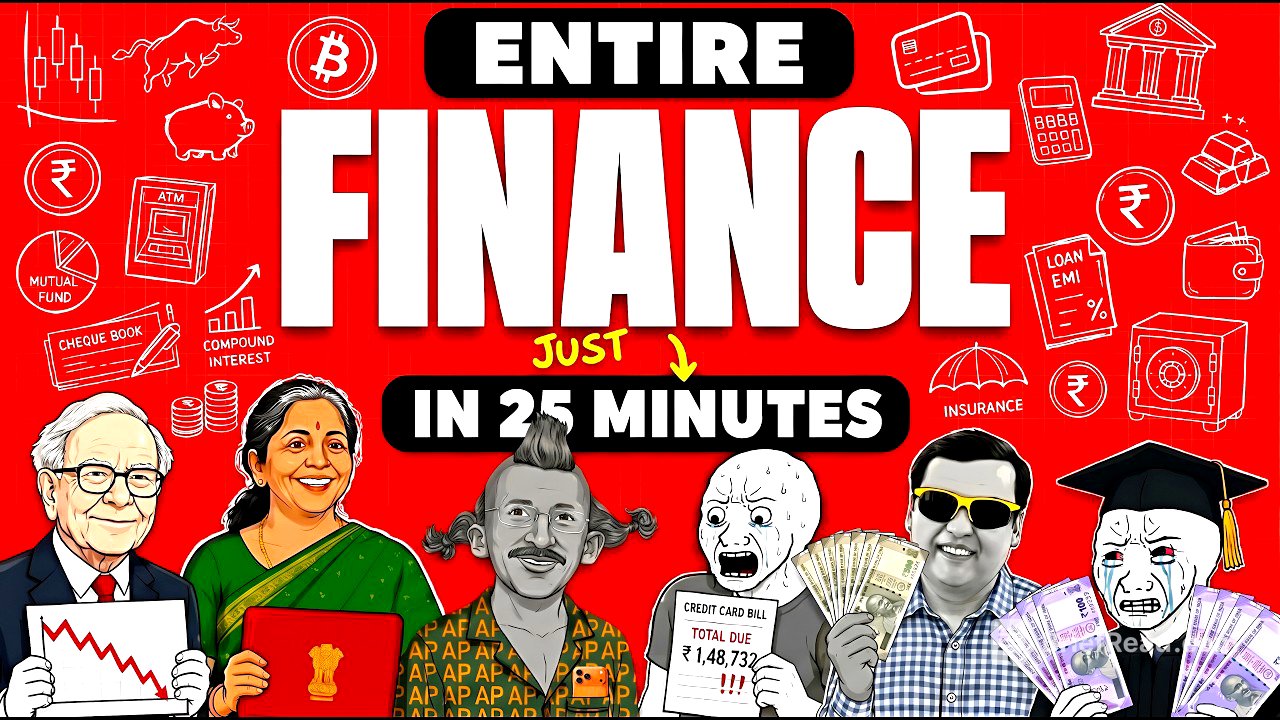
This video explains the fundamental concepts of money, wealth, and financial literacy through a story about two characters, Kaju and Mota Bhai. It highlights misconceptions about money, the importance of financial education, and the differences between income and wealth. It covers topics such as budgeting, saving, debt, investment strategies, and retirement planning, ultimately leading to the conclusion that true wealth involves understanding and managing one's finances effectively.
- Understanding the true nature of money as a tool for trade, not wealth itself.
- Differentiating between income (which sustains) and wealth (which liberates).
- Key financial concepts including budgeting, saving, investing, and managing debt.
Intro [0:00]
The video introduces the idea that many people mistake physical cash or digital numbers in bank accounts for real wealth. It emphasizes that understanding money is about comprehending why people work, the effects of inflation, and why some remain poor despite high salaries.
Problems before Money [0:23]
Historically, people relied on barter systems for trade, which posed significant problems such as double coincidence of wants. This led to difficulties in measuring value and highlighted the necessity for money, a tool that serves as a medium of exchange, unit of account, and store of value. Money, therefore, acts as a system that helps people exchange their value effectively.
Basic Work [0:24]
The video contrasts two characters: Kaju, who is financially illiterate but works hard, and Mota Bhai, who understands financial principles. Kaju mistakenly believes that having cash in the bank equates to wealth, while Mota Bhai knows that true wealth lies in assets like property and stocks.
Stored Efforts and Choice [1:24]
Money represents stored effort and choices. When one earns money through labour, they convert their effort into currency, which can then be exchanged for goods and services. Those who possess money can command the time and labour of others, revealing money’s real power.
Character Intro [1:46]
Kaju and Mota Bhai are introduced as representing two different mindsets towards money. While Kaju focuses solely on earning income, Mota Bhai understands the importance of asset creation, demonstrating the differences in their financial outlooks.
What Money Is NOT [2:04]
Money should not be mistaken for wealth. It is merely a system facilitating trade and is effective based on trust within society. The intrinsic value of money comes from societal belief, and understanding this helps navigate financial challenges.
Income vs. Wealth [2:42]
Income is a flow of money (like salaries), while wealth consists of what one owns that generates ongoing value (assets). Kaju’s expenses align with his income, leaving him financially vulnerable, while Mota Bhai constructs wealth through strategic asset accumulation.
Building Assets [3:29]
Building wealth does not require millions; it can start small. Assets include stocks, real estate, and personal skills. Financial literacy is critical in transforming income into wealth, and stories from the past additionally highlight the necessity of patience and strategic planning.
Patience & Trap [4:00]
Many expect quick returns and fall into traps, such as get-rich-quick schemes. Understanding concepts like the time value of money and compounding interest is essential to avoid financial pitfalls and enhance wealth accumulation over time.
Time Value [4:30]
The time value of money asserts that money available today is worth more than the same amount in the future due to its potential earning capacity. Delaying investments can cause significant financial loss in the long run.
Compounding [4:57]
Compounding refers to earning interest on interest, which can exponentially grow investments over time. Regularly investing money at a young age can lead to substantial wealth, illustrating the power of patience and consistency in saving and investing.
Cash Flow [5:56]
Cash flow management is crucial for financial wellbeing. Positive cash flow, where income exceeds expenses, ensures financial stability, while negative cash flow leads to wealth depletion. It's vital to focus on how money flows in and out rather than merely increasing income.
Budgeting [6:44]
Budgeting is not merely a restriction but a way to direct spending. It helps track fixed, variable, and discretionary expenses, avoiding 'invisible leaks' that can diminish savings.
50/30/20 Rule [7:30]
The 50/30/20 rule divides income into three categories: 50% for needs, 30% for wants, and 20% for savings. This framework facilitates smart financial habits, helping individuals build wealth through controlled expenditure.
Finance Secret [8:35]
Financial literacy is vital for understanding the significance of saving before spending. Wealth involves intentional saving and prudent spending habits, where saving becomes a primary expense rather than an afterthought.
Saving [8:53]
Saving is essential for survival and opportunity. It's crucial for financial stability in emergencies and for future investments. Distinguishing between saving (low risk) and investing (higher risk with potential for high returns) is essential for financial growth.
Saving Pyramid [9:29]
The saving pyramid outlines a step-by-step approach to financial management: start with income, then save regularly, create an emergency fund, invest for growth, and finally accumulate wealth that provides passive income.
Banking System [11:07]
Banks are not merely safe lockers for money; they facilitate lending and borrowing. Understanding how banks operate helps individuals make informed decisions regarding where their money is placed and how it is compounded.
Fractional Banking [11:46]
Fractional banking allows banks to lend a portion of deposits while keeping a reserve. This practice can lead to money multiplication in the economy but poses risks if many depositors withdraw their funds simultaneously.
RBI & Repo Rate [12:30]
The Reserve Bank of India (RBI) controls money supply through repo rates, impacting the economy. A higher repo rate makes loans expensive, thus reducing market demand and controlling inflation, while a lower rate encourages borrowing and spending.
Debt [14:30]
Debt represents spending future income today. It can be beneficial if used wisely (good debt) for investments, but detrimental when used for personal consumption (bad debt). Understanding credit scores is critical in managing debt.
EMI Trap [15:13]
EMIs can create a false sense of affordability, leading to unsustainable debt levels. Recognising the hidden costs of EMIs is essential for long-term financial health.
Cashless Society [15:32]
In a cashless society, the lack of physical currency reduces the psychological pain of spending, leading individuals to overspend without realising the implications on their finances. It's essential to maintain discipline in such environments.
Leverage [16:16]
Leverage allows individuals to control larger investments using smaller amounts of their own money. It can amplify returns but also must be used wisely to avoid potential losses.
Mannat Example [17:06]
The example of Shah Rukh Khan's property, Mannat, illustrates how leveraging debt can produce significant returns. Investments should aim for positive cash flow that covers debts and generates profits.
Banking Trick [18:22]
Banks use your deposited funds to offer loans at higher interest rates, benefiting from the difference. Understanding this cycle can bring greater awareness about personal finances and banking practices.
Insurance [18:51]
Insurance does not create wealth but protects against financial disasters. Having health and term life insurance ensures financial security against unforeseen events.
Investing Basics [20:15]
Investing involves placing money into assets that grow in value or yield regular income. Recognising the importance of investing to combat inflation and build wealth is crucial to achieve financial independence.
Retirement Planning [21:40]
Effective retirement planning is essential for financial freedom, where passive income exceeds expenses. Early saving and investing significantly influence retirement outcomes.
CONCLUSION [23:28]
The video emphasizes that financial literacy is crucial for avoiding financial ignorance, forming healthy financial habits like budgeting and systematic saving. The ultimate goal is financial freedom, achieved through knowledge and disciplined financial behaviour.