TLDR;
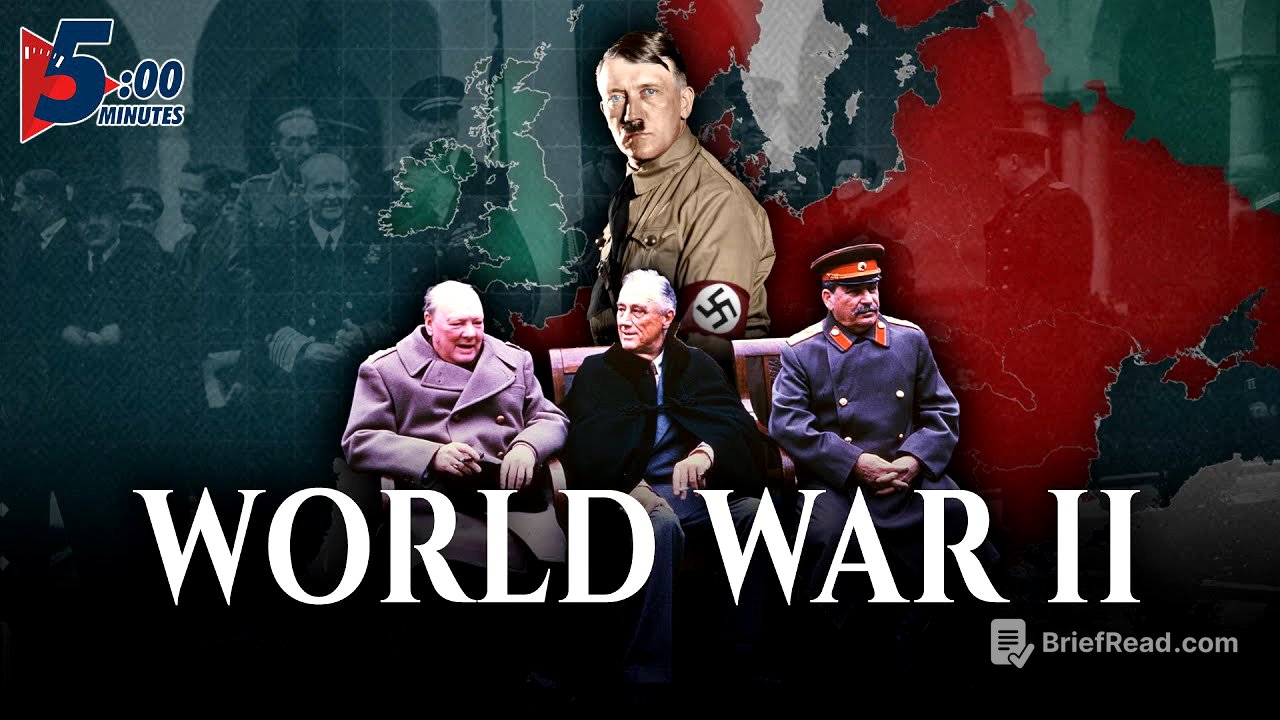
This video provides a concise overview of World War II, from its origins in the aftermath of World War I and the rise of Hitler, to the key events, major players, and devastating consequences of the conflict. It covers the expansionist policies of the Axis powers, the Allied response, and the eventual defeat of Germany and Japan, highlighting the war's immense human cost and its lasting impact on the global political landscape.
- The war began with Germany's invasion of Poland in 1939 and ended with Japan's surrender in 1945 after the atomic bombings of Hiroshima and Nagasaki.
- Key turning points included the Battle of Stalingrad, the Battle of Midway, and the D-Day invasion of Normandy.
- The conflict resulted in approximately 60 million deaths and led to the formation of the United Nations and the emergence of the US and the Soviet Union as superpowers.
Origins of World War II [0:11]
World War II, a global conflict spanning from 1939 to 1945, pitted the Axis powers (Germany, Italy, and Japan) against the Allied forces (Britain, the Soviet Union, the US, and China). Adolf Hitler rose to power in 1933, capitalising on the global economic depression and German resentment towards the Treaty of Versailles. He asserted the superiority of the German race and the need for "Lebensraum" (living space), initiating a military build-up in violation of the treaty.
Early Axis Expansion [0:39]
Initially, France and Britain adopted a policy of appeasement, allowing Hitler to expand German territory by uniting with Austria and annexing Czechoslovakia. However, the invasion of Poland in September 1939 triggered declarations of war from Britain and France, marking the start of World War II in Europe. Germany swiftly conquered Denmark, Norway, Belgium, the Netherlands, and France by mid-1940, employing the "Blitzkrieg" tactic of rapid, overwhelming force.
The Battle of Britain and Expansion into North Africa [1:46]
In the summer of 1940, Germany launched an aerial assault on Britain, known as the Blitz. Despite heavy bombing of London and other cities, the German Luftwaffe failed to overcome the Royal Air Force. Italy, under Mussolini, further expanded the war by invading parts of North Africa and launching an unsuccessful campaign in Greece.
Operation Barbarossa and the Eastern Front [2:17]
In 1941, Germany initiated Operation Barbarossa, a surprise invasion of the Soviet Union. Millions of Jews and communists were exterminated behind the lines. Although initially successful, the invasion became a major setback for Germany due to the vastness of the country, poor roads, harsh winters, and Soviet resistance. By 1943, after the battles of Stalingrad and Kursk, Germany was forced into a full-scale retreat.
The Pacific Theatre [3:04]
In the Pacific, Japan seized Manchuria in 1931 and launched a surprise attack on Pearl Harbor in December 1941, prompting the US to join the war against the Axis powers. Japan expanded throughout Southeast Asia and the Pacific, committing war crimes, but its advances were halted after the Battle of Midway in 1942.
Allied Counter-Offensives and the Fall of the Axis [3:47]
Germany and Italy suffered a decisive defeat against the British at the Battle of El Alamein in 1942. In 1943, after Mussolini's regime collapsed and the Allies landed in Sicily, Germany took control of Italy. The Soviets advanced across Eastern Europe, and in June 1944, Allied forces launched the D-Day invasion of Normandy, beginning the liberation of France.
The End of the War and its Aftermath [4:35]
Allied forces closed in on Germany from both the East and West, leading to Germany's surrender in May 1945 after the Soviet invasion of Berlin and Hitler's suicide. By spring 1945, most of Japan's conquests had been liberated. Following bombing campaigns and Japan's refusal to surrender, the US dropped atomic bombs on Hiroshima and Nagasaki. Japan surrendered in September 1945 after the Soviet invasion of Manchuria. World War II resulted in approximately 60 million deaths and led to the creation of the United Nations, increased political and economic integration, and the emergence of the US and the Soviet Union as superpowers.