TLDR;
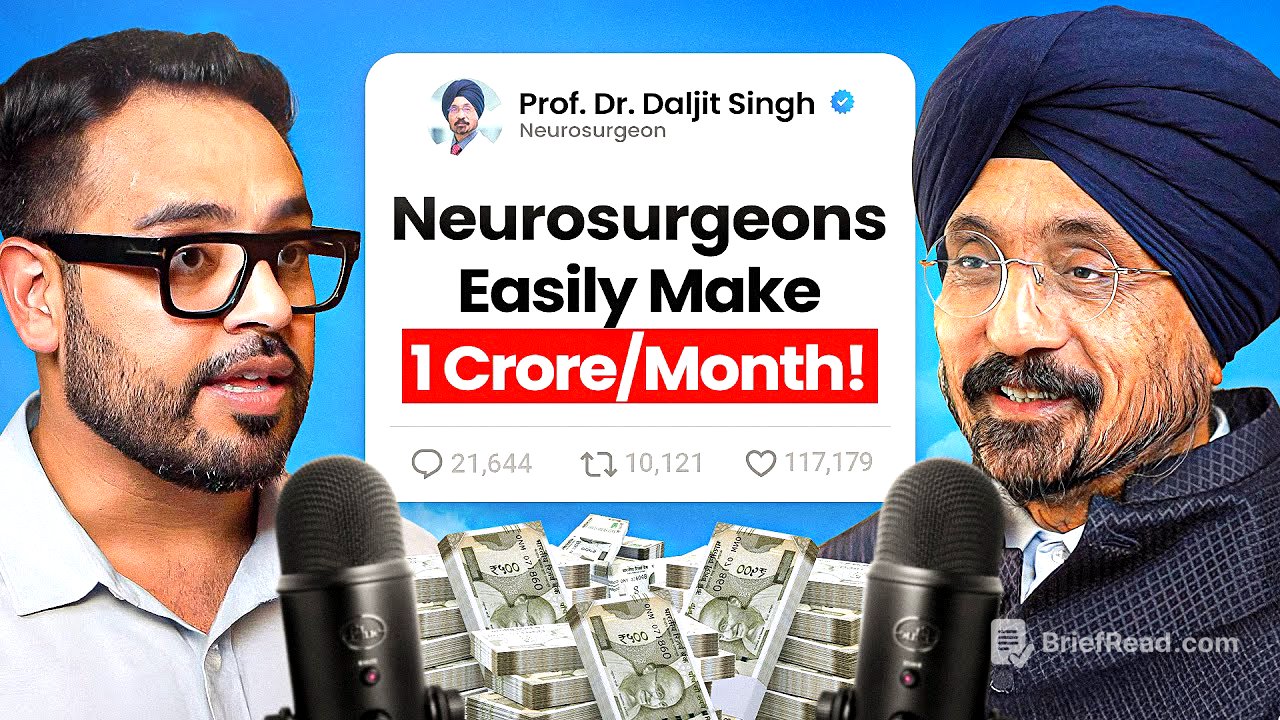
This episode of The Nachiket Bhatia Show features Dr. Daljit Singh, a highly experienced neurosurgeon, discussing various aspects of neurosurgery in India. He shares his journey into medicine, the evolution of neurosurgery, and insights into the field's challenges and future. Key points include:
- The transformation of neurosurgery due to technological advancements like CT scans and microsurgery.
- The debate between MCH and DNB courses and the importance of sub-specialization.
- The impact of AI on medicine and the ethical considerations surrounding it.
- The need for better compensation and respect for doctors in India.
Introduction and Dr. Daljit Singh's Background [0:53]
The Nachiket Bhatia Show introduces Dr. Daljit Singh, a renowned neurosurgeon with over 35 years of experience. Dr. Singh is a BC Roy awardee and has held prominent positions at Max Super Speciality Hospital and GBP Hospital. He has performed over 12,000 brain and spine surgeries and trained thousands of MCH applicants. The episode aims to explore various facets of neurosurgery with Dr. Singh's expertise.
Journey into Medicine and Surgery [2:29]
Dr. Singh recounts his early life and education in Allahabad and Delhi. He initially aimed for medicine but entered through the second attempt and later joined MS surgery after not getting medicine in the first list. A pivotal moment occurred when he almost switched to medicine but ultimately stayed in surgery due to a missed connection with a friend. He believes this was destined by nature, leading him to neurosurgery. He emphasizes that success is more meaningful with struggle and encourages embracing failures.
Academic and Professional Career [8:03]
After completing his MS and MCH in neurosurgery, Dr. Singh briefly worked in the private sector before securing a pool officer position. He then became an associate professor of neurosurgery at Maulana Azad Medical College (MAMC) and GBP Hospital, where he served for over 35 years. Currently, he is the Vice President of Neurosurgery at Max Super Speciality Hospital and heads neurointervention. He has trained over 150 MCH students and finds satisfaction in their success.
BC Roy Award and MAMC's Significance [10:17]
Dr. Singh discusses receiving the BC Roy award, the highest recognition in Indian medicine, specifically for being an eminent medical teacher. However, he cherishes the distinguished alumnus award from MAMC the most, as it represents recognition from his peers and teachers. He reflects on what made MAMC special, highlighting its excellent faculty, student involvement, and the collective wisdom imbibed by its culture.
MAMC vs. AIIMS [12:51]
While MAMC was once a top institution, Dr. Singh acknowledges that many others have risen to its level. He notes that MAMC needs to match international standards and lacks exposure to global medical education. He differentiates AIIMS from MAMC, pointing out AIIMS's superior budget allocation, mandatory research for faculty promotions, and greater autonomy. He suggests that AIIMS's structure allows for better polishing of talent due to fewer governmental controls and better facilities.
Medical vs. Non-Medical Spouses [17:30]
Dr. Singh shares his personal experience of marrying outside the medical fraternity, with his wife being a High Court judge. He believes that medical professionals should not necessarily marry within the field. While medical spouses may understand the profession's demands better, marrying a non-medical person broadens one's perspective and knowledge of other disciplines. He emphasizes that a successful marriage depends on the relationship and not just the profession.
Evolution of Neurosurgery [20:20]
Dr. Singh divides neurosurgery in India into three phases: before 1990, 1990-2020, and the current era matching global standards. He recalls a time when neurosurgery had high mortality rates and limited diagnostic tools. The invention of the CT scan revolutionized the field, along with advancements in microscopy, neuromonitoring, and neuroanesthesia. These developments have significantly improved outcomes and reduced mortality rates.
MCH vs. DNB in Neurosurgery [24:28]
Dr. Singh differentiates between the MCH and six-year DNB courses in neurosurgery. He suggests that the longer five-to-six-year courses generally produce better neurosurgeons due to more focused training from the beginning. However, he cautions that those unsure about specializing in neurosurgery should first pursue general surgery. He acknowledges that neurosurgery can be demanding and stressful, so clarity of purpose is essential.
Toxicity and Demands of Neurosurgery [27:26]
Dr. Singh refrains from calling neurosurgery "toxic," instead describing it as "demanding." He highlights that the brain is an unforgiving organ, requiring constant vigilance and quick responses. The scope for error is limited, and one must anticipate and address issues promptly. He notes that while long working hours are a concern, the field has become more rewarding due to improved results and changing perceptions.
Long Working Hours and Career Graph [30:47]
Dr. Singh acknowledges the issue of inhumane working hours, which is a global problem. While spending more time with patients leads to better learning and satisfaction, he recognizes the need for doctors to care for themselves. He points out the disparity between the rising population and the number of doctors. Regarding career paths, he mentions the evolution of sub-specialties like endovascular, stereotactic, and pediatric neurosurgery. He advises pursuing further training in these areas to master specific skills.
Sub-Specialties and Future Potential [36:42]
Dr. Singh believes all neurosurgery sub-specialties are equally important, with epilepsy surgery and functional neurosurgery being in high demand. He anticipates growth in pediatric neurosurgery and spine surgery. He emphasizes that neurosurgery will remain relevant due to ongoing trauma, stroke cases, and brain tumors. He also foresees advancements in gene therapy and genetic engineering for treating neurological conditions.
AI in Medicine [39:46]
Dr. Singh clarifies that AI will not replace doctors but serve as an additional tool for better patient care. He welcomes AI as a means to enhance surgeons' performance and improve outcomes. However, he cautions against relying entirely on AI-generated reports, emphasizing the need for human oversight and responsibility. He views AI as a helpful tool for reducing errors and improving diagnostic accuracy.
Doctors' Compensation and Violence Against Doctors [44:50]
Dr. Singh addresses the issue of underpaid doctors in India compared to other countries. He believes doctors need to advocate for better compensation, recognizing the extensive training and commitment required. He stresses that unless the government and public value medical professionals, the healthcare system will suffer. He also expresses concern over the rising violence against doctors, calling for societal treatment and greater respect for the profession.
Government vs. Corporate Sector [50:43]
Dr. Singh explains his choice of the government sector due to his initial interest in academics and teaching. He acknowledges that the private sector now offers better healthcare delivery and education. While government institutions provide exposure to a high volume of patients, private sectors often produce better results due to better facilities and senior-level involvement.
AIIMS Expansion and Government Medical Colleges [53:08]
Dr. Singh initially had reservations about the expansion of AIIMS but now sees it as a positive step. He believes these institutions have created well-equipped centers in various states and attracted academics. However, he suggests that state government medical colleges could be improved instead. He notes that central government funding makes it easier to establish AIIMS-like institutions.
Non-Financial Advantages in Government Sector [56:40]
Dr. Singh mentions non-financial advantages in the government sector, such as academic leaves for attending conferences and presenting papers. He notes that while some centers of excellence have financial support for international travel, it still doesn't match the level of support provided to AIIMS.
Neurosurgeon's Earning Potential [58:27]
Dr. Singh discusses the earning potential of neurosurgeons, which varies based on the sector and location. Government sector salaries range from ₹90,000 to ₹1 lakh for senior residents, potentially reaching ₹3-4 lakhs for professors. In the private sector, earnings can range from ₹6-8 lakhs per month, with some top neurosurgeons earning up to ₹1 crore per month.
General Surgeons vs. MCH Graduates [1:00:30]
Dr. Singh believes that general surgery alone is becoming increasingly difficult to sustain, especially in major cities. He suggests that general surgeons may need to shift to smaller cities or pursue super-specialization. He notes that the public increasingly seeks specialist doctors.
Six-Year DNB vs. Three-Year MCH [1:02:29]
Dr. Singh compares six-year DNB and three-year MCH courses, stating that those with six years of focused training generally have better subject knowledge. However, he acknowledges that individual passion and learning ability also play a significant role.
Fellowships and Medical Tourism in India [1:03:50]
Dr. Singh lists various fellowships available in neurosurgery, such as endovascular, epilepsy, and spine fellowships. He mentions that the Neurological Society of India (NSI) provides guidance and financial support to students. He envisions India becoming a hub for medical tourism, with many from neighboring countries coming to learn neurosurgery.
Top Institutes for Neurosurgery [1:06:56]
Dr. Singh lists top institutes for neurosurgery in India, including AIIMS, Sri Chitra, SGPGI, and GB Pant. He notes the significant evolution of Indian neurosurgery and the improved skills of young neurosurgeons.
Top Medical Specialties [1:08:24]
Dr. Singh identifies neurosurgery as a top specialty in terms of gratifying work. He also mentions oncology, plastic surgery, and transplant as promising fields. He notes a decline in cardiac surgery due to the rise of interventional procedures.
Rapid Fire Round [1:10:38]
In a rapid-fire round, Dr. Singh shares spontaneous and truthful answers. He says his first podcast guest would be his wife. If he could swap lives, he would choose to be part of the Neurolink team to address ethical concerns. He questions the ethical implications of Neurolink and emphasizes the complexity and mystery of the human brain.