TLDR;
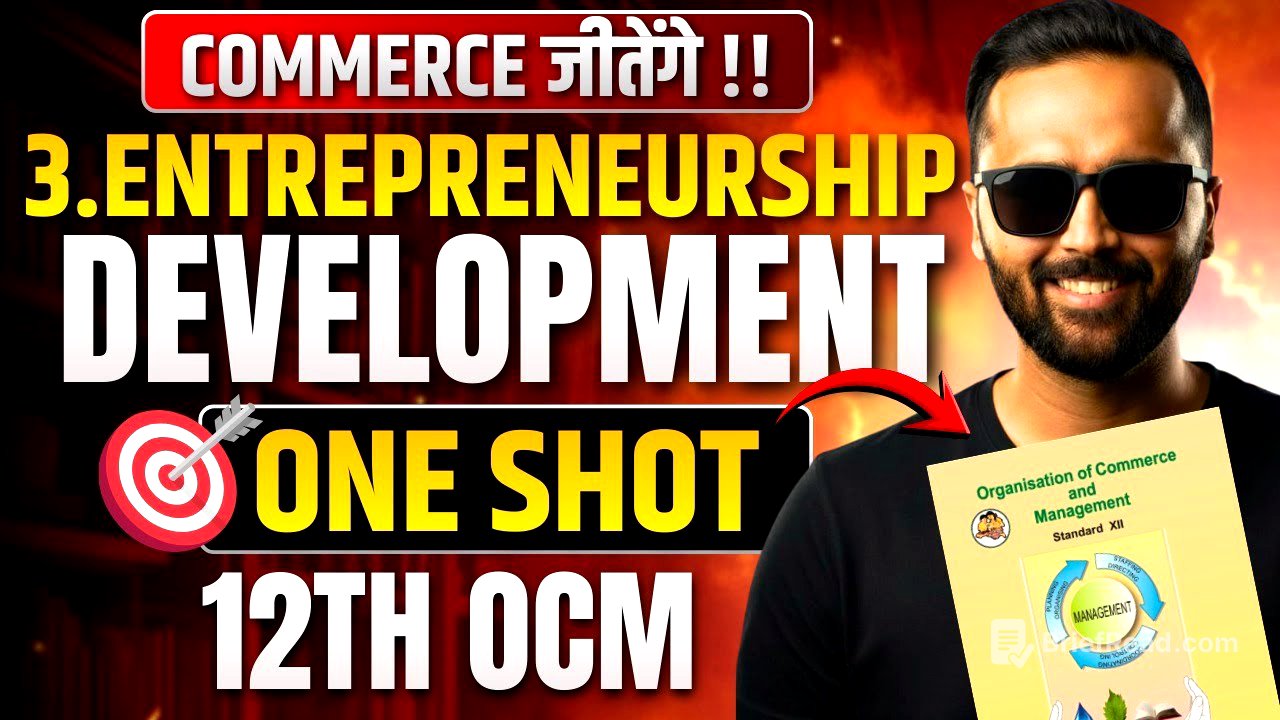
This video provides a comprehensive overview of entrepreneurship development, covering the definition of an entrepreneur, the characteristics and qualities of successful entrepreneurs, the functions they perform, and the processes involved in entrepreneurship development. It also touches on recent initiatives in India to promote entrepreneurship, such as Startup India, and introduces the concept of agrotourism and intrapreneurship.
- Definition and characteristics of entrepreneurship
- Qualities and functions of successful entrepreneurs
- Entrepreneurship development process and recent initiatives
- Agrotourism and Intrapreneurship
Introduction to Entrepreneurship [0:00]
The video introduces the concept of entrepreneurship, defining an entrepreneur as someone who takes risks, makes decisions, and creates jobs for others. Entrepreneurship is described as the activity of starting and running a business with hard work and innovative ideas. Entrepreneurs are considered the fourth factor of production, contributing significantly to a country's growth and development. The term "entrepreneur" has evolved over time, initially referring to military leaders in France in the early 1500s, then builders and architects in the 1700s, and later business persons. In India, entrepreneurship gained momentum after independence as the government began supporting and encouraging new businesses to overcome industrial and financial challenges.
Concept of Entrepreneur [2:49]
The concept of an entrepreneur is further explained, noting that the term is derived from the French word "entreprendre," meaning to start something. An entrepreneur is a person who starts and runs a business, taking risks to earn money. The video highlights that business and risk are inherently linked, as success and failure are uncertain. A definition from a website dictionary is provided, stating that an entrepreneur is someone who starts a business and willingly risks losses to make money.
Characteristics of an Entrepreneur [3:54]
The characteristics of an entrepreneur are detailed, starting with intellectual capability, which includes being smart, creative, and able to logically analyze business situations and make decisions. Entrepreneurs should understand future market trends and adapt to changes in the business world. Hard work is essential, especially when starting a new business, requiring long hours and handling multiple tasks. Technical knowledge of products, processes, and technology is also crucial, along with continuous updating with the latest innovations. Communication skills are necessary for interacting with customers, suppliers, and workers, fostering clear idea sharing and planning. A highly optimistic attitude helps entrepreneurs view problems as opportunities, and risk-bearing capacity involves calculating risks and preparing solutions. Self-confidence is also key, with entrepreneurs believing in their ability to achieve their goals.
Qualities of a Successful Entrepreneur [6:47]
Qualities of a successful entrepreneur include being disciplined, which means focusing on goals and avoiding distractions, creating clear plans, and following them step by step. Confidence in one's abilities is vital, avoiding self-doubt. An open-minded approach allows for identifying new business opportunities in every situation. Being a self-starter involves taking initiative and not depending on others. A competitive nature drives entrepreneurs to excel and make their companies the best. Creativity enables thinking from different perspectives and finding innovative solutions. Determination ensures perseverance through challenges, and strong communication skills facilitate effective interaction with employees and customers. A strong work ethic means being the first to arrive and the last to leave, and passion for the work is more important than money, driving continuous improvement.
Functions of an Entrepreneur [9:53]
The functions of an entrepreneur are outlined, beginning with innovation, which involves creating new products or improving existing ones to satisfy customers and solve business problems. Setting clear objectives and striving to achieve them is crucial, although goals may change with market conditions. Market development involves finding new ways to buy and sell goods, increasing demand through market research, and growing the market. Adopting new technology helps improve production and business performance through modern machines and scientific methods. Maintaining good relations with employees, managers, and suppliers creates a cooperative atmosphere. Organizing funds involves finding and efficiently utilizing money to maximize profit. Finally, taking timely decisions requires careful consideration of advantages and disadvantages to choose the best option.
Entrepreneurship Development [12:11]
Entrepreneurship development is defined as an activity where businesses are started and run with clear goals, performed by individuals or groups to earn profit by producing and selling goods. Key characteristics include innovation, economic activities, organization building, creative ideas, managerial skills, leadership, risk-bearing, and gap-filling functions. Innovation involves creating new products and technologies, while economic activities focus on producing goods and services to meet customer needs. Organization building involves bringing together resources like land, labor, and capital for production. Creative ideas lead to new and improved products, and strong managerial skills and leadership guide teams and ensure business success. Risk-bearing involves investing in uncertain future markets, and gap-filling involves identifying and addressing market needs with new products and solutions.
Process of Entrepreneurship Development [16:00]
The process of entrepreneurship development includes training and Entrepreneurship Development Programs (EDP). Training is a planned method to teach skills, provide knowledge, and shape attitudes for successful entrepreneurship. It helps understand marketing, production, and customer needs, improves efficiency, reduces waste, adopts new technology, and promotes teamwork. Training methods include lectures, demonstrations, individual and group instructions, and attending meetings, seminars, and conferences. EDPs are programs that help people become successful entrepreneurs by identifying and motivating them, training them to manage businesses, and guiding them in starting new enterprises. First introduced in Gujarat in 1970, EDPs involve infrastructure development, selecting potential entrepreneurs, identifying business ideas, conducting training programs, selecting trainers, using appropriate training methods, conducting training, and following up on progress. The objectives of EDPs include encouraging entrepreneurship growth, optimizing resource use, developing backward regions, creating employment opportunities, and expanding small and medium-scale industries.
Recent Initiatives in Entrepreneurship Development [19:25]
Recent initiatives in entrepreneurship development include Startup India, which promotes entrepreneurship through various programs. A startup is defined as a company headquartered in India, less than 10 years old, with an annual turnover of less than 100 crore. The government supports entrepreneurs through programs like the "Start-up India" initiative, which aims to create 10 lakh mobile app startups, and the Mudra Bank Scheme, which provides loans at low interest rates. The goal is to transform India from a job seeker to a job creator. Launched in 2016, Startup India aims to create an ecosystem that helps startups grow, fosters economic growth, and increases employment. Key actions include simplifying rules and procedures, providing funding support and tax exemptions, and fostering industry-academia partnerships and incubation. Objectives include creating a 10,000 crore startup funding pool, reducing patent registration fees, streamlining bankruptcy processes, providing tax exemptions for three years, promoting self-certification, and introducing innovation programs in schools.
Startup India Scheme and Agrotourism [22:46]
The Startup India scheme helps SC, ST, and women entrepreneurs obtain bank loans to start new businesses, providing loans between 10 lakh and 1 crore. Each bank must have at least one SC/ST borrower and one woman borrower. Loans are for new enterprises in manufacturing, servicing, or trading, with 51% shareholding controlled by SC, ST, or women entrepreneurs. Eligible entrepreneurs must be over 18 years old, and loans are for greenfield projects. The loan is a composite of term loan and working capital, with interest rates lower than other banks. Borrowers must contribute 25% of the project cost. Agrotourism involves providing rural and farming experiences, including outdoor activities like tracking and fishing, learning experiences like farming activities, entertainment like harvest festivals, hospitality like farm stays, and on-farm sales of products.
Intrapreneurship [26:23]
Intrapreneurship is defined as a system where an employee, not necessarily the owner, is motivated to bring new ideas and invest in the company's growth. The intrapreneur does not invest their own money but brings innovative ideas to grow the business. An intrapreneur is an employee with the authority and responsibility to use innovative and creative ideas to grow the company. Unlike entrepreneurs, intrapreneurs do not invest their own money or take financial risks; the company provides the necessary resources. Their ideas may or may not generate immediate revenue, but they continue to receive a salary.