
TLDR;
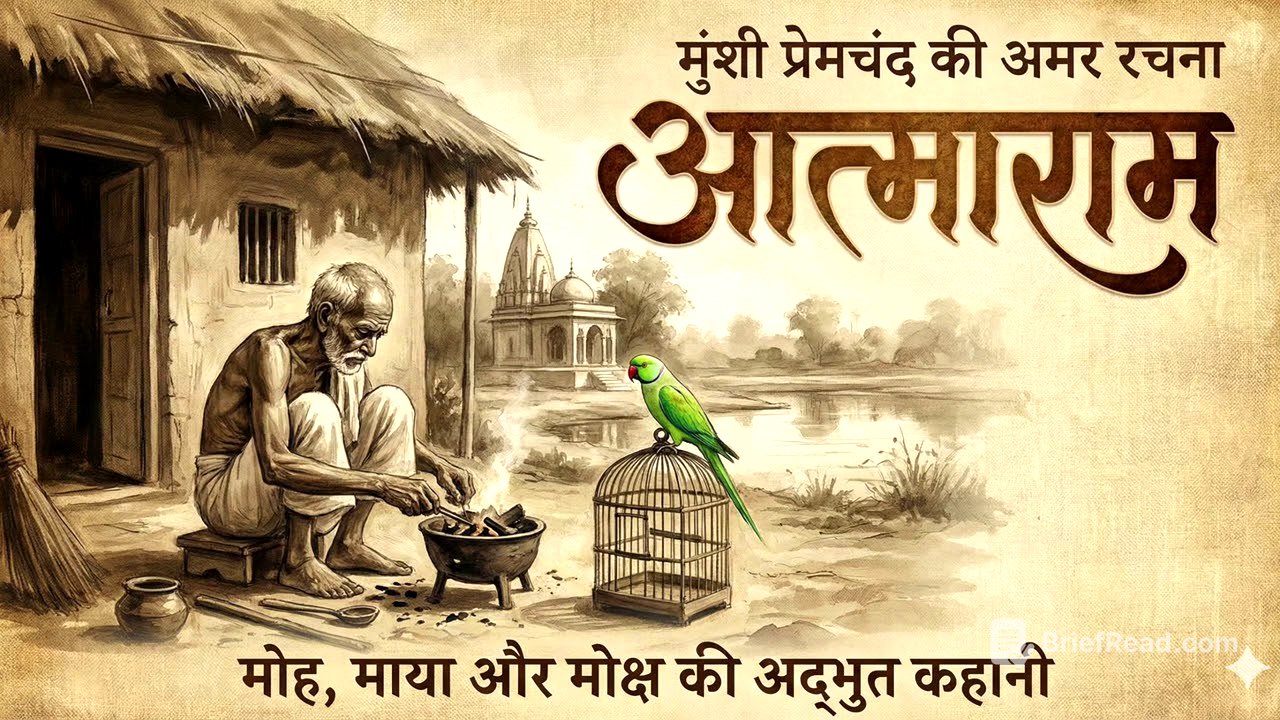
This is a summary of Munshi Premchand's story "Atmaram," which explores themes of redemption, detachment, and the illusion of worldly possessions through the life of Mahadev Sonar, a village goldsmith. Initially consumed by greed and estranged from his family, Mahadev's life takes a turn when his beloved parrot, Atmaram, escapes. This event leads him to a hidden treasure, which he uses to atone for his past misdeeds and bring peace to his village.
- The story is set in the rural village of Vedgram, where Mahadev Sonar is known more for his eccentric habits than his profession.
- Mahadev's life transforms after his parrot, Atmaram, escapes, leading him to discover a hidden treasure.
- He uses the treasure to atone for his past misdeeds, offering restitution to those he cheated and contributing to the village's welfare.
Intro [0:00]
The channel introduces itself as a source of heart-touching, true, and classic Hindi stories, encouraging viewers to subscribe for more content. It promises to deliver stories that offer new strength and inspiration. The story "Atmaram" by Munshi Premchand is introduced as a profound narrative about the human mind's entanglement with worldly illusions and the ultimate attainment of peace. It tells the story of a man rejected by the world and forgotten by his family, who finds a path to salvation through a bird.
Mahadev's Life in Vedgram [0:52]
The story is set in Vedgram, a typical Indian village with old traditions. Mahadev Sonar, a goldsmith, is a well-known figure in the village, but more for his strange habits than respect. He spends his days in a small room, his "Sahiban," hammering gold, a sound that becomes the village's daily clock. Mahadev's routine is rigid: he wakes up before dawn, carrying a parrot in a cage to the village pond, chanting "Sadguru Dutt Shivdutt Data Ram ke charan mein chitt laga," which serves as the village's morning alarm.
Family and Professional Troubles [2:02]
Mahadev's family life is unhappy, despite having three sons, daughters-in-law, and many grandchildren. His sons are only interested in his wealth and wish for his death so they can inherit it. Mahadev is often neglected, sometimes not even given food, and he retreats to his room to smoke his hookah in solitude. Professionally, he faces distrust due to his skill in manipulating gold, leading to constant accusations of cheating his customers.
The Escape of Atmaram [5:24]
Mahadev's only solace is his parrot, Atmaram, whom he considers a friend, son, and god. One day, a child accidentally opens the cage, and Atmaram flies away. Mahadev is devastated and frantically searches for the bird, realizing how much he values the companionship and peace it brings him. He is in a state of distress, as the parrot is more than just a pet; it's a symbol of the peace and affection he lacks in his life.
The Search and the Taunts [6:58]
Mahadev spots Atmaram on a rooftop and tries to lure him back with affection, but the villagers mock him, turning his plight into a spectacle. The parrot, frightened by the noise, flies further away to an orchard. Mahadev, despite his age and physical condition, desperately chases after the bird, ignoring his failing health and the jeers of the villagers.
The Night in the Orchard [8:32]
Mahadev continues his pursuit into the hot afternoon, his feet burning on the ground. He pleads with Atmaram to return, but the parrot remains elusive. As evening approaches, Mahadev is exhausted and sits under a tree, refusing to leave despite his hunger and thirst. He fears losing Atmaram forever, as the parrot is the only thing that makes him feel alive.
Discovery of the Treasure [10:51]
In the middle of the night, Mahadev hears voices and sees a group of men gathered around a fire. He approaches them, hoping for company and a smoke, but they flee in fear, revealing a hidden pot. Mahadev discovers the pot contains gold coins. Overjoyed and fearful, he hides the treasure, his mind racing with plans and anxieties about his newfound wealth.
Dreams and Fears [15:33]
Mahadev's mind fills with dreams of a better life, including a grand house, a jewelry shop, and the respect of his family. He also plans to go on pilgrimages, perform grand ceremonies, and build a temple and well for the village. However, he is also plagued by the fear of being robbed or killed for the treasure. He tests his ability to run, finding a renewed vigor in his fear and greed.
Atmaram's Return and Mahadev's Transformation [17:06]
As dawn breaks, Mahadev hears Atmaram's familiar call and sees the parrot return to the cage. Overjoyed, Mahadev realizes the parrot's escape has led him to a profound transformation. He acknowledges his past sins and feels a deep sense of gratitude and devotion. He plans to encase Atmaram's cage in silver and gold, symbolizing the bird's value to him.
Atonement and Redemption [18:57]
Mahadev returns home and hides the gold. He then seeks out the village priest, announcing his intention to host a Satyanarayan Katha (religious discourse). During the gathering, Mahadev confesses his past dishonesty and offers to repay anyone he has wronged, without requiring proof or witnesses.
The Month of Restitution [22:13]
Initially, no one comes forward, but the priest falsely claims Mahadev owes him money, which Mahadev promptly pays. Despite the lack of claimants, Mahadev spends the next month waiting for those he has wronged to seek restitution. He abandons his old habits, welcomes visitors, and becomes known for his generosity.
Legacy [24:50]
By the end of the month, no one has come to claim anything. Mahadev realizes the inherent goodness in people and understands that the world reflects one's own character. The story concludes by describing the transformed village of Vedgram, now featuring a temple built by Mahadev, a pond with thriving aquatic life, and a memorial to Atmaram. Mahadev's legacy lives on through these contributions, and villagers sometimes claim to hear Atmaram's call near the pond at night. It is said that Mahadev eventually renounced the world and went to the Himalayas, his name forever linked with Atmaram.