
TLDR;
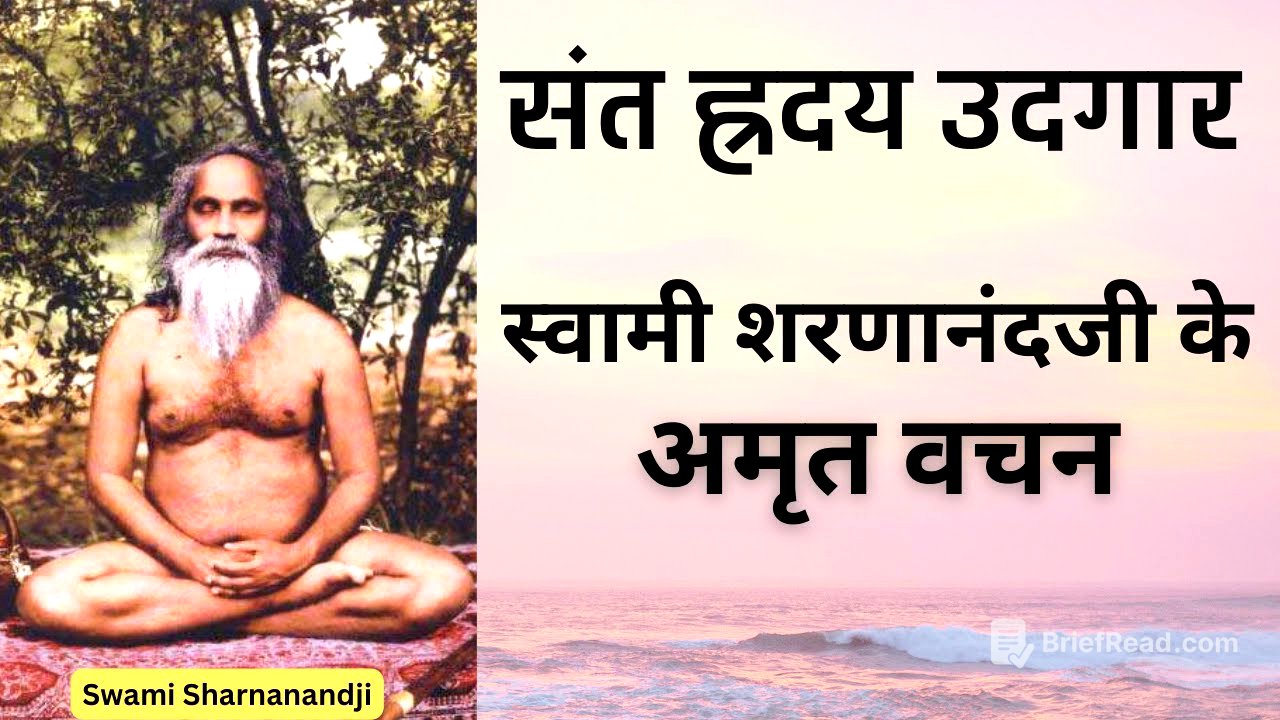
This video features Swami Shri Sharananand Ji Maharaj discussing profound truths about life, spirituality, and the path to self-realization. He emphasizes the importance of detachment, faith in God, and recognizing the divine presence within oneself and in all things. The teachings encourage a shift in perspective from self-centeredness to selfless service and devotion, highlighting that true freedom and happiness come from relinquishing desires and embracing God's will.
- Three keys to solving life's problems: wanting nothing, believing God is ours, and recognizing everything belongs to God.
- Focus on self-improvement rather than criticizing others.
- True devotion means living a life that reflects belief in God, not just intellectualizing it.
- The importance of detaching from desires and surrendering to God's will for inner peace and freedom.
Three Keys to Solving Life's Problems [0:16]
Swami Shri Sharananand Ji Maharaj explains that three principles can resolve all of life's problems: wanting nothing ("mujhe kuch nahi chahiye"), believing that God is always with us ("prabhu apne hain"), and understanding that everything belongs to God ("sab kuch prabhu ka hai"). Accepting these truths leads to generosity, independence, and love. He advises against focusing on others and instead directing attention towards the divine, as focusing on worldly matters distracts from true spiritual connection.
The Importance of Recognizing God [0:58]
The Maharaj expresses concern that those who believe in God often struggle to remember Him, which he considers a source of sorrow and astonishment. He contrasts this with how easily people remember deceased relatives or lost wealth. He suggests that the difficulty in remembering God stems from not truly considering Him as one's own. Recognizing one's own flaws is a sign of thoughtfulness, while seeing flaws in others indicates foolishness. Acknowledging God's presence within oneself is crucial for spiritual realization.
The Essence of True Belief [2:44]
The true measure of believing in God is reflected in one's life, not just in thoughts. Abandoning pride and having unwavering faith in God's grace leads to receiving that grace. God's grace is constantly showering blessings of yoga, knowledge, and love, but we often fail to utilize it. Taking moments of silence allows one to experience the grace and power of God, offering yoga, love, and knowledge.
The State of Deep Sleep as a Spiritual Metaphor [4:21]
In deep sleep, one naturally relinquishes attachment to even the most beloved objects and people, experiencing no suffering. This state provides a glimpse into a life beyond material possessions and personal relationships. If one can achieve a similar state of detachment while awake, the illusion of lack disappears, revealing that life exists independently of external things and is inherently complete.
The Impact of Belief on Life [5:34]
Many people believe in God and understand the reality of the world, but the impact of this knowledge on their lives is what truly matters. If one knows that remembering God brings well-being but still struggles to focus the mind on Him, it is a form of atheism. Seeing God in specific objects is incomplete devotion; complete devotion means recognizing that nothing exists apart from God, now, in the past, or in the future.
The Significance of Connection and Need [6:27]
Something's existence is meaningless without a personal connection, which only forms when there's a need. If one finds comfort without God, it's like a beautiful room without a friend or a decorated woman without her husband—akin to a body without a soul. The absence of belief in God leaves one feeling alone in life. Doing nothing makes life useful for oneself, while doing the right things makes life useful for the world.
The Trap of Ego and Desire [7:20]
Believing that one must act to receive is a misconception that distracts from the eternal life within. Constantly inflating one's ego makes one unappealing to others. Even the desire to be selfless or detached can be a form of ego. True selflessness arises when one acts for the benefit of all without any sense of personal pride or desire for recognition.
The Path to Progress and the Greatest Teacher [8:47]
Thinking, listening, and acting for others leads to significant progress without obstacles. Conversely, focusing solely on oneself leads to perpetual poverty. The most influential teacher is one who teaches through their life, while the worst engages in gossip and criticism. Duty spreads through dedication, not through instruction, preaching, or coercion.
The Nature of Desire and Liberation [10:33]
One who desires nothing can truly love and be free. Personal experience shows that one's desires often lead to downfall. Surrendering to God's will, which unfolds naturally, is the path to well-being. A person without desires is the king of kings, while one with minimal desires is wealthy. Desire is the root of anger, and even good desires can cause sorrow.
The Divine Plan and True Devotion [12:03]
God does not fulfill desires but liberates devotees from them. Dying with desires is death, while desires ceasing while alive is liberation. When things go against one's wishes, it means God is fulfilling His plan. Approaching God with desires turns Him into the world, but approaching the world without desires turns it into God. Therefore, approach God to love Him and the world to serve, expecting nothing in return.
The Pitfalls of Desire and the Divine Gift [13:11]
Demanding something from God severs the true connection. If one seeks truth while harboring desires for falsehood, they will only experience the falsehood. Desires create a barrier between oneself and God. Divine grace provides essential things without asking and withholds unnecessary things even when requested. Asking for anything reflects ignorance and disrespect towards God's benevolent plan.
The Nature of the Senses and the Divine Perspective [14:19]
It's natural for the senses to be drawn to the world, as that is their nature. However, one should question why they prefer the world over God, as they belong to God. Attributing faults to the present based on past mistakes is unjust. While past actions have consequences, dwelling on past faults creates a flawed mindset.
The Essence of True Worship and Guidance [15:15]
Worship and prayer should be directed towards God. A guru can be a father figure but is not God. While a guru's words can be divine and worthy of respect, they are not objects of personal affection. If one is to see God in a person, it should be in everyone. A guru is a means to an end, not the end itself.
The Power Within and the Nature of Life [15:50]
Today, there is less need for instruction and more for individuals who can embrace teachings. What great leaders and nations cannot achieve, one can achieve alone if they choose. Scriptures consider becoming a leader or guru as a cause for downfall, suggesting this path is only suitable for great souls. A seeker should avoid such entanglements. Life protects itself; if life remains, the means for living will arise.
The Illusion of Worldly Support and True Knowledge [17:09]
Relying on the world for support keeps one in the realm of death. Life is not merely the existence of the body; true life is realized after detachment from the body. What one calls knowing and understanding is merely learning. True knowing means fully realizing that one owns nothing in this vast world and desires nothing.
The Importance of Self-Respect and True Renunciation [17:59]
A seeker who does not respect their own knowledge cannot respect the knowledge of gurus or scriptures. Just as one who doesn't use their eyesight cannot benefit from the sun's light, action is not a means to knowledge but a provider of experiences. Confining oneself in a hut does not equate to renunciation if one hasn't renounced their ego. True renunciation is the renunciation of the self, and true love is love for all.
The Illusion of External Renunciation and True Freedom [19:03]
Merely leaving home or changing clothes does not lead to enlightenment or love. This is not renunciation but an escape from one's duties. Everyone relinquishes beloved objects and people in deep sleep. God, religion, and society always reward those who sacrifice for them. True renunciation is without awareness, as the memory or existence of sacrifice only remains until the act is complete.
The Source of Doubt and the Divine Watch [20:01]
Voices against God arise not from logic but from the actions of those who claim to believe in Him. God embraces those burdened by present suffering, not dwelling on past mistakes. God constantly watches over His creation and never loses sight of anyone, even if they forget Him.
The All-Encompassing Nature of God and the Path to Belonging [21:06]
God is not confined to one place; rather, He encompasses everything, including the world, knowledge, and devotion. Those who belong to no one and have no one become God's own, as He is the protector of the orphaned. The question of God's nature is irrelevant to those who belong to Him. Just as thirst doesn't question water or hunger doesn't question food, satisfaction eliminates the distinction between the two.