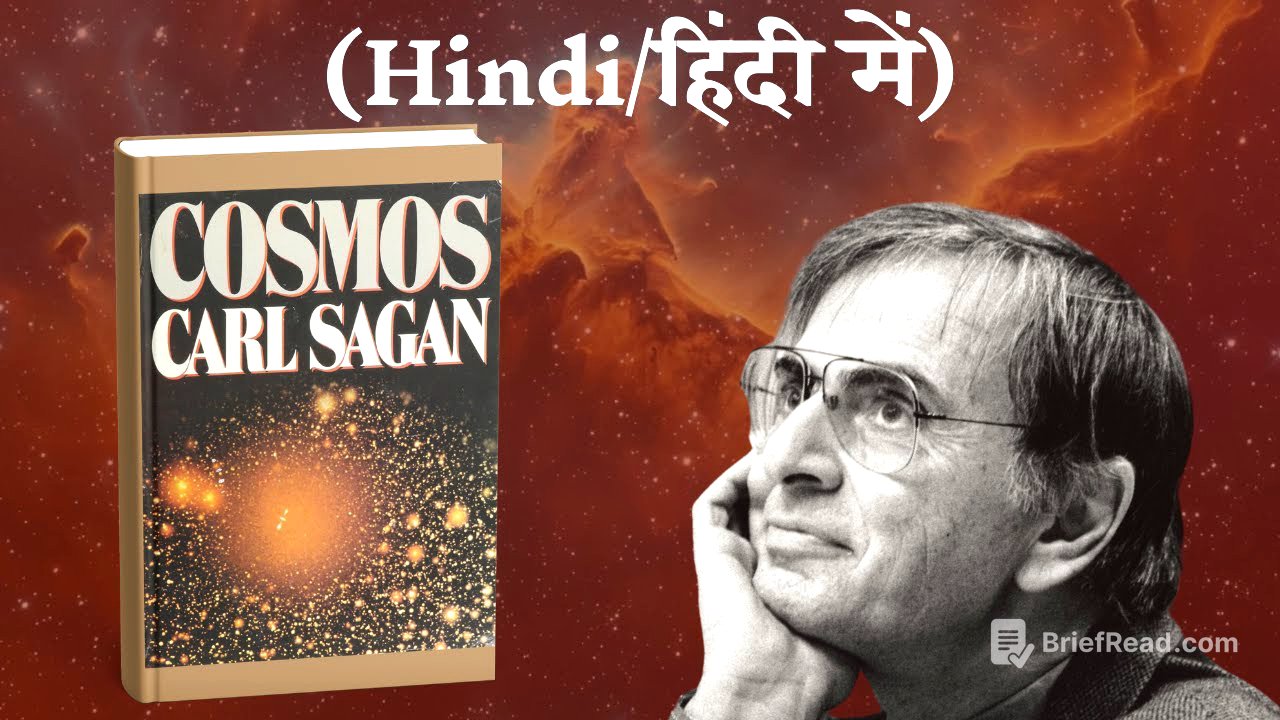
TLDR;
This video summarizes Carl Sagan's "Cosmos," a book that explores the vastness of the universe, the history of scientific discovery, and humanity's place within the cosmos. Sagan emphasizes the importance of scientific skepticism, imagination, and the pursuit of knowledge. He discusses various topics, including the scale of the universe, the evolution of life, the search for extraterrestrial intelligence, and the potential for both heaven and hell on Earth and beyond. The book encourages readers to embrace a cosmic perspective and to safeguard our planet and species for future generations.
- The universe is vast and ancient, filled with wonders and mysteries.
- Science is a self-correcting process that helps us understand the universe.
- Imagination and skepticism are essential for scientific progress.
- Humanity has a responsibility to protect Earth and explore the cosmos.
- The search for extraterrestrial intelligence is a worthwhile endeavor.
Introduction [0:01]
Carl Sagan's "Cosmos" is more than just a book; it's a journey into the universe and the depths of human thought. Sagan, an astronomy and space sciences professor, made science accessible to the general public, explaining complex concepts in a way that anyone can understand. He highlights science as a self-correcting process, driving new discoveries and a deeper understanding of the universe. Sagan also shares personal experiences, such as the Viking Lander mission and the creation of the "Cosmos" TV series, which reached 140 million people worldwide. "Cosmos" provides scientific knowledge and opens a door to exploring the mysteries of the universe and contemplating our future.
The Scale of the Cosmos [1:43]
Sagan describes the cosmos as everything that ever was, is, and will be, emphasizing that even our smallest thoughts can lead us to the universe's greatest mysteries. He illustrates the vastness of space, noting that Earth is a tiny speck in the grand scheme of things. The discoveries made about the universe in recent millennia are astonishing and unexpected, reminding us of humanity's capacity for thought and understanding. Imagination allows us to explore worlds that may not exist, while skepticism helps us distinguish between fact and fiction. Due to the immense dimensions of the cosmos, distances are measured in light-years, with one light-year equaling approximately 10 trillion kilometers. Earth is unique as the only place where life as we know it has been found, though Sagan believes the chances of life elsewhere in the universe are high. Galaxies are described as sea frost in the ocean of space, each containing billions of stars, many of which may have planets. Our own Milky Way galaxy contains 400 billion stars, but we only know one, the Sun, well. Star systems vary, with some being single stars like the Sun and others being double or multiple star systems. Stars have unique properties, with blue stars being hot and young, yellow stars being middle-aged, and red stars being elderly.
A Rare Gem in the Cosmos [5:09]
Each star system is like an island in space. Planets like Mars, with its volcanic activity and sandstorms, might support simple forms of life. The Sun, a powerful star, generates light through thermonuclear reactions. Earth is a rare gem in the cosmos, where life originated and evolved. Our passion for exploring the cosmos is our destiny. Earth is our home, where we continue our journey, perhaps one day completing our long voyage.
Eratosthenes and the Library of Alexandria [6:05]
Carl Sagan discusses Eratosthenes, who lived in Alexandria and was known as "Beta" because his competitors claimed he was second in everything. However, Eratosthenes was actually "Alpha" in many fields. He calculated the circumference of the Earth using observations of shadows in Alexandria and Syene, demonstrating that the Earth is round. This calculation, made 2200 years ago, was remarkably accurate. Sagan also praises the Library of Alexandria, the largest research institute of its time, where scholars from various fields gathered and vast amounts of knowledge were collected. Over time, fear of knowledge led to the library's destruction, with only fragments surviving. Thinkers like Eratosthenes learned much from this library, providing new perspectives to the world. Eratosthenes' discoveries inspired voyages of exploration, including those of Columbus, who manipulated Eratosthenes' calculations to make his voyages seem feasible.
The Big Bang and the Scholars of Alexandria [8:50]
Sagan emphasizes that our curiosity and bravery help us understand the universe. The universe is approximately 15 to 20 billion years old, originating from the Big Bang. Since then, matter and energy have been transforming. Sagan highlights the contributions of Alexandrian scholars such as Euclid, Dionysius, Hierophilus, Hieron, Apollinus, Archimedes, and Ptolemy, who made significant advancements in astronomy, geometry, language, physiology, engineering, and mathematics. Today, technology allows us to explore space in ways previously impossible. From above, we can see Earth's shape and continents, confirming predictions made by ancient geographers. We are exploring our backyard, space, and may one day complete our long voyage.
Evolution and the Nature of Life [10:22]
Evolution, an ancient philosophical concept, was suppressed during the millennium of theological scholasticism. Charles Darwin revived this idea, breaking old constraints and demonstrating that it is a better way to understand the universal order. All organic beings that have ever lived originated from a single primordial form. This perspective highlights the wonder of life, which has evolved from simple beginnings while the planet orbits according to fixed laws of gravity. Carbon atoms play a central role in this process. There was a time when life did not exist, but now our world is full of it. This raises questions about how life first appeared, how it evolved, and how complex beings like us came to explore the mysteries of our origins and other planets orbiting distant suns. If extraterrestrial life exists, will it be based on organic molecules like us? Will these beings look like us, or will they have evolved with different adaptations for different environments? Sagan's "Cosmos" questions the nature of life and the implications of searching for life on other planets, viewing these as two sides of the same question: Who are we?
Cosmic Inevitability and Natural Selection [12:30]
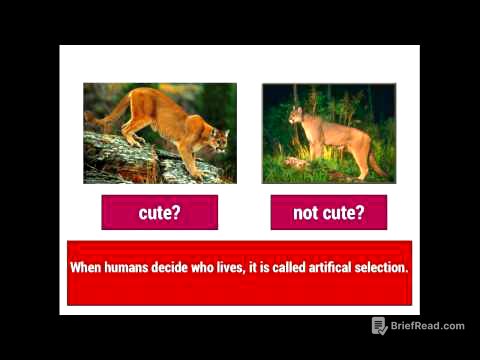
Dark areas between stars contain clouds of gas, dust, and organic matter. Radio telescopes have detected various organic molecules, suggesting that the raw materials for life are widespread. Given enough time, the origin and evolution of life may be a cosmic inevitability. Among the billions of planets in the Milky Way galaxy, some may harbor intelligences and civilizations more advanced than our own. Earth is described as imperfectly suitable for life. Earthlings are well-adapted to our environment because we evolved here. Organisms that were not well-adapted died out. We descend from organisms that thrived. Organisms evolving on different worlds would also appreciate their environments. Artificial selection involves humans encouraging certain physical and behavioral traits in plants and animals while discouraging others. The encouraged varieties reproduce preferentially and become abundant, while the discouraged varieties become rare or extinct. If humans can create new varieties, nature can too, through natural selection.
Extinction and the Cambrian Explosion [14:42]
Many species have gone extinct during evolution, representing terminated experiments. Before the Cambrian explosion, species evolved gradually. This may be partly due to incomplete information. Early Earth organisms had few hard parts, resulting in a sparse fossil record. However, the emergence of new forms was genuinely slow before the Cambrian explosion. The painstaking evolution of cell structure and biochemistry is not directly reflected in fossil records. After the Cambrian explosion, new adaptations appeared rapidly. Fish and vertebrates emerged, plants colonized land, insects evolved, and their descendants pioneered the colonization of land by animals. Winged insects and amphibians appeared, followed by trees and reptiles. Dinosaurs evolved, then mammals, birds, and flowers. Dinosaurs eventually went extinct. The earliest cetaceans, ancestors of dolphins and whales, arose, and primates, including monkeys, apes, and humans, also evolved. Less than 10 million years ago, creatures closely resembling human beings evolved, accompanied by a spectacular increase in brain size. A few million years ago, the first true humans emerged.
Molecular Basis of Life [16:51]
There are tens of billions of known kinds of organic molecules, but only about 50 are essential for life's activities. The same patterns are used repeatedly, conservatively, and ingeniously for different functions. Proteins, which control cell chemistry, and nucleic acids, which carry hereditary instructions, are at the molecular heart of life. We are all made of the same stuff, sharing a common ancestor. A living cell is as complex and beautiful as galaxies and stars. The elaborate machinery of a cell has evolved over 4 billion years. Food fragments are converted into cellular machinery. Human DNA is a ladder billions of nucleotides long. Most possible combinations of nucleotides are nonsense, coding for proteins that perform no useful function. Only an extremely limited number of nucleic acid molecules are useful for life forms. The ways to put nucleic acids together are vast, probably far greater than the total number of electrons and protons in the universe. Evolution works through mutation and selection.
Mutation and Adaptation [18:40]
Mutations occur during replication when enzymes like DNA polymerase make mistakes, changing nucleotides or tying knots in nucleic acids. If the mutation rate is too high, we lose 4 billion years of evolution. If it is too low, new varieties are unavailable. Remarkable adaptations occur when this balance is achieved. Three billion years ago, some one-celled plants combined to form multi-cellular organisms. Perhaps a mutation prevented a cell from splitting, leading to the evolution of the first multi-cellular organisms. Sex was invented about 2 billion years ago. Before that, new varieties arose only from random mutations, letter by letter changes in genetic instructions, making evolution slow. With the invention of sex, two organisms could exchange entire paragraphs, pages, and books of DNA code. 600 million years ago, the Cambrian explosion occurred, with new life forms evolving rapidly. Oceans teemed with trilobites, large insects, but trilobites no longer exist. Their fossils show how dynamic and unpredictable evolution is. Every species arrives and departs in its time, illustrating the ongoing process of evolution.
The Harmony of Worlds [20:50]
This chapter explores the concept of a predictable yet dynamic universe, where patterns and rules allow for understanding and learning. In ancient times, people lacked modern technology but had the night sky. Stars held a strange magic, with people creating stories and patterns around them. Constellations are not real formations but products of human imagination. Seventeenth-century European sailors named constellations after telescopes, microscopes, and compasses. Ancestors observed tailed stars, or falling stars, which followed patterns, indicating predictability in the sky. This permanence offered comfort, like a familiar story with a happy ending. The sky served as a calendar, with star and sun positions predicting seasons. Science and astrology began together, but astrology became entangled with mysticism and superstition, attributing effects on human life to planets. Astrology was a combination of observation, mathematics, fuzzy thinking, and fraud. Personal astrology developed 2000 years ago, linking planet positions to human lives. Words like "disaster" (bad star) and "influence" (astral impact) show astrology's deep cultural integration.
Astrology vs. Astronomy [25:08]
Astrology remains popular, with horoscopes in daily newspapers, while astronomy coverage is rare, reflecting cultural preferences that sometimes overshadow scientific curiosity. The sky is an ancient mirror, reflecting ancestors' fears and hopes. Looking at and understanding the sky, whether through science or astrology, is a universal journey connecting us all. Sagan provides a simple test for astrology using twins, noting that despite being born at the same time and place with the same planetary positions, their lives often differ significantly. This failure in science-based tests shows astrology is a pseudoscience. The sky has always inspired civilizations, with astronomical symbols on national flags. The United States flag has 50 stars, Japan has the sun, and Australia has the Southern Cross constellation. India's flag features the Ashoka Chakra, a cosmological symbol. These flags reflect a universal connection, achieved through science rather than astrology, linking to themes of matter origin, Earth's habitability, and human evolution.
Ptolemy and the Geocentric Model [27:31]
Babylonian astrology codified planetary motion rules. Ptolemy's era saw confusion between astrology and astronomy, with horoscopes linking planetary positions to human traits. Modern astrologers ignore scientific discoveries like the precession of equinoxes and the impact of planetary moons. Astronomy is a science, while astrology is a belief system making claims without evidence. Ptolemy believed Earth was the center of the universe, a natural idea since Earth seems immovable. He created a model with spheres and off-center wheels to explain planetary motion, predicting retrograde motion. This model dominated until the medieval period, with the Church's support halting astronomical progress for a millennium.
Copernicus and the Heliocentric Model [28:48]
In 1543, Nicholas Copernicus proposed a sun-centered universe, with Earth as a planet orbiting the sun. This model better explained planetary motion but angered many. The Catholic Church banned Copernicus's book, but his model marked a new beginning, paving the way for a scientific revolution advanced by Kepler and Galileo.
Johannes Kepler and the Harmonies of the World [29:36]
Johannes Kepler, born in Germany in 1571, studied at a Protestant Seminary, training in Theology but drawn to Geometry and Natural Harmonies. He considered Geometry divine, existing before creation as God's mind. Kepler lived in an era of superstitions and religious dogmas but believed that if the world was God's creation, it should be closely examined. This thought process led him beyond astrological misconceptions. Kepler viewed universe patterns and planetary motion as harmonies. Kepler's thinking teaches us that by understanding nature's book, we can better understand our universe.
Kepler's Laws of Planetary Motion [30:39]
In 1589, Kepler went to the University of Tübingen for clerical studies, where he was introduced to Copernicus's heliocentric model. Before becoming a clergyman, he accepted an offer to teach mathematics in Graz, Austria. Kepler struggled with classroom teaching, but one day, he conceived an idea: why only six planets? He linked this to Pythagoras's platonic solids, believing planet orbits were decided by these solids, a proof of God's design. However, without accurate astronomical data, his model did not match observations. Tycho Brahe, a Danish nobleman and observer with accurate planetary observations, invited Kepler to Prague to use his data. Tycho, described as flamboyant and arrogant, did not fully share his data with Kepler but provided enough for him to analyze Mars's precise observations. Kepler rejected circular orbits, declaring Mars's orbit elliptical after three years of calculations, forming his first law of planetary motion: A planet moves in an ellipse with the sun at one focus. Kepler also observed that planets move faster near the sun and slower when farther away, leading to his second law: Planets sweep out equal areas in equal times.
Kepler's Tragic Life and Universal Laws [33:00]
Kepler's third law of planetary motion, mathematically relating planetary motion, was described in his book "The Harmonies of the World." He wrote that the squares of the periods of the planets are proportional to the cubes of their average distance from the sun. This law perfectly defines the solar system's clockwork. Kepler imagined a physical cause for planetary motion, suggesting the sun's gravitational influence as a magnetic force, a groundbreaking contribution: astronomy is a part of physics. This idea marked a significant shift from a mystical heaven to a scientific universe. Kepler's life was tragic; during the Thirty Years' War, he lost his wife and son to an epidemic. Religious conflicts and financial struggles hampered his career, yet he continued his scientific work. Kepler's laws are universal, explaining spacecraft missions, binary star studies, and galaxy motions. His vision was a foundation for modern astrophysics. Kepler saw his discoveries as a divine harmony, writing, "I am writing the book to be read either now or by posterity. It matters not. It can wait a century for a reader as God himself has waited 6,000 years." Kepler bridged ancient mysticism and modern science, decoding the universe's laws for us.
Kepler's Somnium and Isaac Newton [34:59]
Kepler's "Somnium," a science fiction book aimed at spreading knowledge, described a journey to the moon, where travelers observed Earth rotating slowly. This book attempted to explain the concept of Earth's rotation. Kepler described the moon as filled with mountains and valleys, with creatures adapted to their local environments, though he incorrectly believed the moon had an atmosphere and seas. He attributed the circular shape of craters to an intelligent race, highlighting his blend of science and imagination. Isaac Newton, born in 1642 on Christmas Day, had a weak and lonely childhood. He studied at Cambridge and, during the plague, developed calculus, optics, and universal gravitation while living in Woolsthorpe village. Newton's law of universal gravitation explained that the same force that makes an apple fall also keeps the moon in orbit. Newton defined gravitation as an inverse square law.
Newton's Laws and the Legacy of Kepler and Newton [36:34]
These laws apply to all planets, moons, and stars. Newton's laws were theoretical, based on Tycho and Kepler's observations. Kepler and Newton gave science a universal philosophy, respecting data and understanding nature's fundamental laws. Kepler provided empirical laws of planetary motion, and Newton provided their theoretical basis. Their work made modern science and space exploration possible. Newton wrote of his discoveries, "I do not know what I may appear to the world, but to myself, I seem to have been only like a boy playing on the seashore while the great ocean of truth lay all undiscovered before me." This humility and dedication characterized both Kepler and Newton.
Heaven and Hell: Cosmic Catastrophes [37:32]
Earth seems beautiful and peaceful, but natural history shows it has faced devastation. Humans sometimes create their own destruction with weapons. Records from Earth and other planets indicate that major catastrophes are possible. On June 30, 1908, a massive fireball was seen in the sky over the Tunguska region of Siberia, destroying 2,000 square kilometers of forest. The Russian government did not investigate until 19 years later.
The Tunguska Event and Cometary Impacts [38:48]
Various explanations for the Tunguska event have been proposed, including an antimatter collision, a mini black hole, or an extraterrestrial spaceship crash, but none are strongly supported by evidence. The most credible explanation is that a small comet or asteroid entered Earth's atmosphere, creating a powerful blast and fireball that shook the ground but did not leave a large crater. Small diamonds found at the Tunguska site suggest it was a cometary fragment. These fragments often fall into Earth's atmosphere. The Tunguska event occurred on the day of the Beta Taurid meteor shower, associated with Comet Encke. Sagan notes that a similar event today could be mistaken for a nuclear explosion, potentially triggering nuclear war. It is crucial to understand comets and their impact potential and to improve our monitoring systems.
Comets and Planetary Atmospheres [40:42]
Newton proved that comets orbit in elliptical paths like planets and that their light is reflected sunlight. Edmond Halley predicted the return of a comet seen in 1682, which was later named Halley's Comet. Modern science believes cometary impacts affect planetary atmospheres. Newton suggested that seawater and life on Earth may have originated from comets. William Huggins found organic matter in a comet's tail in 1868. Comets' elliptical orbits contrast with planets' stable circular orbits because planets in elliptical orbits collided and were eliminated early in the solar system.
The Oort Cloud and the Fragility of Earth [42:02]
Beyond Pluto lies the Oort cloud, containing trillions of comets. Passing stars can alter these comets' orbits, sending them toward the sun. Jupiter and Saturn further change their orbits, making them visible near Earth. Their tails are formed by solar wind. Comets and asteroids are remnants from the solar system's formation. Smaller objects are more numerous, leading to more frequent impacts than larger objects. A small comet impact, like the Tunguska event, occurs every few centuries, while larger impacts are less frequent. Sagan emphasizes that Earth is a small and fragile world, and its preservation is our greatest responsibility. Our decisions are important not just for one generation but for the future of humanity.
Mars: Imagination and Exploration [43:28]
Mars has always captured human imagination. It is the closest planet to Earth with a visible surface, featuring polar ice caps, white clouds, dust storms, and a 24-hour day, reminiscent of Earth. Percival Lowell and others believed Mars had canals, suggesting intelligent beings. However, spacecraft imagery revealed that Lowell's canals were optical illusions. There was no evidence of canals or civilizations. Despite this, Mars's dusty soil and underlying mysteries remain captivating.
Rocket Science and the Exploration of Mars [45:01]
Reaching Mars required the development of rocket science, a long journey from Chinese fireworks to the advancements by Konstantin Tsiolkovsky and Robert Goddard. The German V2 rockets and the US-Soviet space race in the 20th century propelled this technology to explore planets like Mars. Multiple missions, including NASA's Viking landers and efforts by European and Asian space agencies, have shown evidence of past water and a potentially habitable environment. Mars exploration is still in its early stages. It is a deserted and cold world with hidden mysteries in its soil. Was there ever life? Can we establish a base there? These questions make Mars exploration exciting.
Terraforming Mars and the Dreams of Space Travel [46:26]
Carl Sagan discusses terraforming Mars, transforming its environment to be Earth-like. This is a challenging and ambitious dream, but a significant step for human curiosity and science. Tsiolkovsky and Goddard envisioned orbiting stations to observe Earth and probes to search for life on Mars, both dreams now realized. From afar, Earth might appear barren, but closer inspection reveals intricate patterns of roads, cities, and farmlands, indicating intelligence. If Mars had such canals and patterns, the theory of intelligent beings would be stronger, but spacecraft imagery has not provided this evidence. Mars's landscape remains a mystery, possibly always lifeless.
The Martian Environment and Viking Landers [47:55]
Mars has a thin atmosphere, mostly carbon dioxide, and cold temperatures. Open bodies of water cannot exist due to low pressure. Scientists have created Mars jars to simulate Martian conditions and experiment with microbes. Some microbes die due to cold, lack of oxygen, or ultraviolet radiation, but others that do not require oxygen survive. The Soviet Union successfully landed on Venus but failed on Mars, with Mars 3 and Mars 6 spacecraft failing after landing. A large global dust storm caused Mars 3 to crash, while the cause of Mars 6's failure remains unknown. Landing sites were analyzed using radar and orbiter imagery, chosen for low elevation and low wind areas. In 1976, Viking 1 and Viking 2 safely landed in the Chryse and Utopia regions. The landscape includes rocks, sand dunes, and red soil. Terraforming Mars involves heating the polar caps to release oxygen and water vapor into the atmosphere, creating a more habitable environment.
Traveler's Tales: Voyager Missions [50:19]
Albertus Magnus questioned whether there are many worlds or just one. Sagan considers this a profound question. Earthlings once believed they were alone, but new inventions have opened new paths. Crossing the sea once seemed impossible, as did reaching the moon, but time has revealed new truths. Today, humans are launching ships into a new sea: space. NASA's Jet Propulsion Laboratory manages the Voyager missions, a prime example. The Voyager spacecraft are sophisticated machines traveling through interplanetary space, passing Jupiter, Saturn, and Uranus. Voyager's cameras sent images of Jupiter and its moons beyond our imagination. Sagan says Voyager missions mark a new chapter, providing not just images of new planets but also demonstrating the capabilities of human thought and engineering.
Voyager's Discoveries and the Human Quest [51:59]
Like the Dutch exploring new seas, we ask new questions and seek new answers with each step. Thinkers like Galileo and Huygens raised new questions, leading us to new solutions. Today, robotic spacecraft like Voyager continue this quest. This is the true story of human exploration. Sagan describes how light from the sun reflects off Europa, one of Jupiter's moons, and is captured by Voyager's television cameras. This light becomes an image read by Voyager's computers and sent back to Earth as a radio signal, a journey of about half a billion kilometers. The signal is received by radio telescopes in Spain, the Mojave Desert in California, or Australia. In 1979, Australia's telescope captured the image of Europa. A computer processes this data, creating an image like a newspaper wire photo, a collection of about a million dots, each showing a shade of gray. After processing, these dots are stored on a magnetic disk, like a phonograph record. Voyager took 18,000 images in the Jupiter system, stored in this way. Finally, an image printed on glossy paper appeared before us, seen by human eyes for the first time on July 9, 1979.
Europa and Io: New Worlds Revealed [54:25]
Sagan writes that Voyager sent a close-up image of Europa, one of Jupiter's four Galilean satellites. The image resembles the imaginary canals of Mars from Lowell's dreams, but the lines on Europa are different. These straight and curved lines form an intricate network. The images revealed that Europa is smooth like a billiard ball, with few mountains or craters. The lines are cracks and grooves of mysterious origin. Sagan imagines a captain's log from a manned Voyager mission: Day 1, successful launch from Cape Canaveral; Day 215, crossed Mars's orbit; Day 475, safely exited the asteroid belt; Day 570, Jupiter looms large in the sky; Day 650, safely crossed Jupiter's radiation belts and newly discovered rings, taking images of moons like Amalthea, Io, Europa, and Callisto. Io, a moon of Jupiter, tells a different story. As Voyager approached, its surface showed a red, yellow, and black multi-colored landscape. Io has active volcanoes erupting molten sulfur. This discovery was made by navigation team member Linda Morabito, who detected a plume above a volcano. Tides caused by Jupiter and Europa's gravity melt Io's interior rocks, resulting in a liquid sulfur ocean surfacing to create new plains.
Titan and the Eternal Voyage [57:00]
Voyager also explored Titan, Saturn's largest moon, with a thick atmosphere rich in methane and organic molecules, making it a potential site for life. Voyager's discoveries were not just about planets but about understanding our origins and the possibilities of life. The Voyager spacecraft are part of an epic voyage, crossing the sea of space, seeking new worlds and new questions. The journey continues, an eternal voyage bringing us closer to the mysteries of our universe.
The Hunter-Gatherers and the Dawn of Understanding [57:48]
There was a time when people did not know science and libraries. People lived as hunter-gatherers, living in the forest and hunting. Every aspect of their lives was connected to nature. They understood animal behavior, hunted them, and learned from them. Rules and stories were their way of life. One day, they saw fire, a sparkling, burning thing. Before that, they only had darkness and stars. Fire became their new friend. They took fire with them, cared for it, and made it their friend. At night, fire gave them light, warmth, and protection from animals. Then they looked at the stars and made stories. Are these stars the campfires of other hunter-gatherers? Or is the sky a big black skin with holes, and the stars are the flames behind those holes? These questions troubled them.
The Gods of Nature and the Ionian Thinkers [59:00]
Hunter-gatherers created metaphors. Gradually, humans began to see these lights as powerful beings or gods. Gods became the rulers of their sky. There was a god for every natural phenomenon: one for the sun, one for the rain, one for life. Human survival depended on the mood of these gods. Droughts, storms, or wars were seen as the anger of the gods. Priests and oracles were created to appease the gods. Human understanding was limited, and nature was a mystery. The questions and stories of hunter-gatherers are the foundation of our science today. Today, we know what stars are: distant, large furnaces. On the Aegean island of Samos, there was a temple dedicated to Hera, the queen of the sky. According to ancient Greek religion, the milky light in the sky was made of Hera's milk, giving rise to the idea of the Milky Way. We are descendants of ancestors who created stories to understand the dangers of life. They had different gods for everything, even love. Every tree and grass had its own nymph or dryad. Humans created gods because nature was unpredictable to them. For thousands of years, people believed that the world was a puppet show with gods pulling the strings.
The Birth of Science in Ionia [1:01:30]
These new ideas arose in Samos and the surrounding islands of Greece. The people here said that everything is made of atoms. Humans and animals evolved from simpler forms. Disease is not the anger of the gods but natural causes. Earth is a planet. Chaos and Night created gods and humans. Chaos was a symbol of unpredictable nature, but in the 6th century BC, Ionian thinkers proposed a new cosmos. They said that the world is understandable because it has order. Nature is not arbitrary.
The Legacy of Thales and Anaximander [1:02:28]
The different islands here had different political practices. No single power could suppress everyone. Writing was accessible to everyone, and ideas were open for debate. Ionia was a place where ideas from Africa, Asia, and Europe met. Thales of Miletus was a great Ionian thinker. He went to Egypt and Babylon and brought back knowledge of astronomy and geometry. He predicted a solar eclipse and measured the height of the pyramids using the shadows and angles of the sun, the same method we use today to measure the mountains of the moon. This approach was the birth of a new idea: to understand the world, we do not need gods. Thales' friend, Anaximander, conducted an experiment using the shadow of a stick to measure the length of the year and the seasons.
Anaximander and the Evolution of Life [1:03:50]
Anaximander believed that the Earth was suspended in the center of the universe without any support. Another remarkable idea of his was that humans and animals evolved from simpler forms. He said that the first animals lived in water, then they came to land. This idea was an ancient form of Darwin's theory of natural selection.
Polycrates and the Tyranny of Samos [1:04:18]
Around 540 BC, Polycrates, a tyrant, ruled in Samos. He built a large security wall that was 6 kilometers long. He built a tunnel to bring water, which ran through a mountain. He was a patron of the arts and sciences. He invited great thinkers like Pythagoras to his court.
Empedocles and the Concept of Atoms [1:04:47]
Empedocles made other tools. Empedocles conducted his first experiment, in which he showed that an invisible substance, which we call air, does not allow water to enter a container. This was the beginning of the idea of atoms and matter. Democritus, who lived in Abdera, proposed that everything is made of atoms, which cannot be divided further. Democritus believed that thought and perception are physical processes and that gods are not involved.
Democritus and the Atomic Universe [1:05:28]
Ionia was the epic center of the birth of science. Thales, Anaximander, and Democritus were great thinkers. Democritus said that everything is a collection of atoms, intricately assembled. Everything, including humans, is a game of atoms and void. When a knife cuts an apple, it passes through the empty space between the atoms. If there were no void, nothing could move. In 1750, Thomas Wright said that Democritus considered the Milky Way to be a collection of numerous unresolved stars without a telescope. He used reason without the aid of optics and thought to infinity.
The Legacy of Democritus and Anaxagoras [1:06:32]
Democritus valued friendship. He believed that happiness is the goal of life, and he did a great