TLDR;
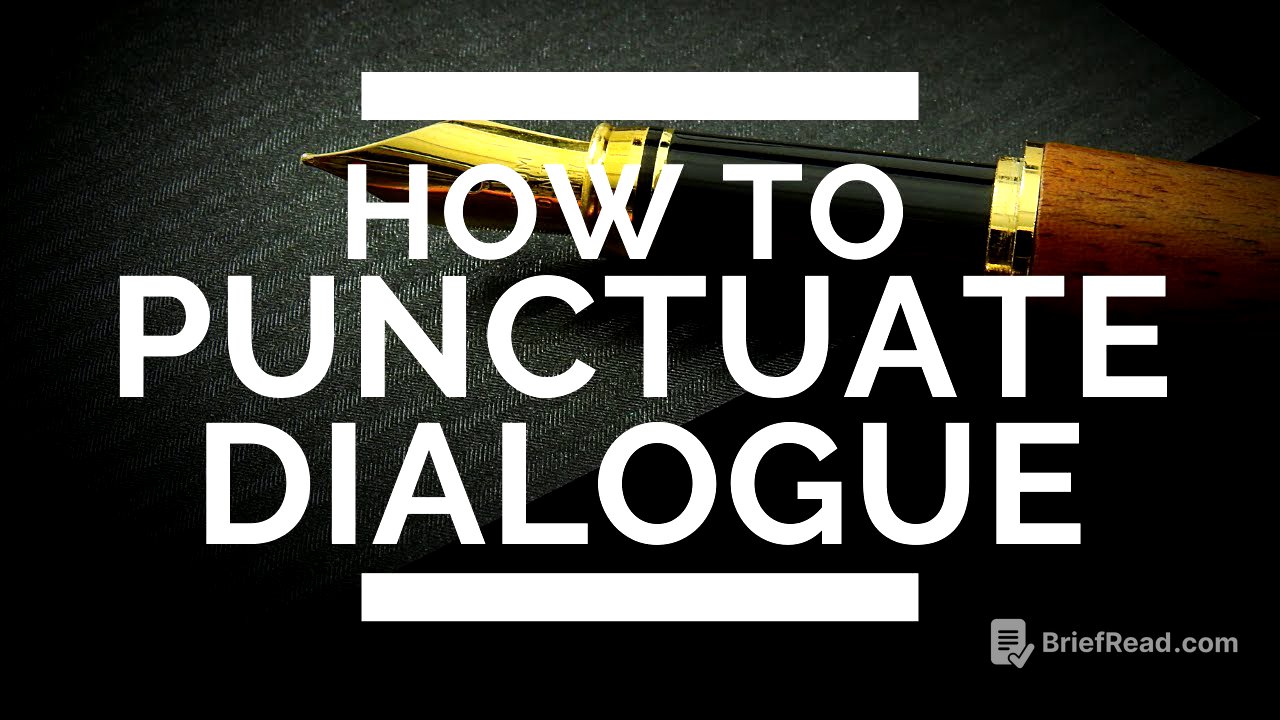
This video provides a comprehensive guide to punctuating dialogue in fiction writing, adhering to the Chicago Manual of Style. It covers the proper use of commas with dialogue tags, distinguishing between dialogue tags and action beats, selecting appropriate verbs for tags, and correctly employing various punctuation marks like m-dashes, ellipses, colons, and semicolons. The video also addresses direct address, contractions, monologues, and the stylistic choice of omitting quotation marks, offering practical examples and corrections to common mistakes.
- Proper use of commas with dialogue tags.
- Difference between dialogue tags and action beats.
- Correct usage of various punctuation marks in dialogue.
Introduction [0:07]
The video introduces common writing mistakes related to dialogue punctuation and emphasizes the importance of mastering this skill. It outlines the topics to be covered, including dialogue tags, action beats, comma placement, verb selection, and various punctuation types. The guidelines are based on the Chicago Manual of Style, the preferred style guide for fiction publishing in the United States, noting that British English and other cultures may have different conventions. A cheat sheet summarizing these guidelines is linked in the video description.
Commas with Dialog Tags [1:24]
Dialogue tags, or speech tags, identify who is speaking and can appear before, after, or in between the dialogue. Commas are placed inside the quotation marks when the tag follows the dialogue, and the tag itself is not capitalized unless it includes a proper noun. When the tag precedes the dialogue, a comma follows the tag and is placed outside the quotation marks, with the first word of the dialogue capitalized. For tags interrupting dialogue, a period follows the tag if it separates two complete sentences, while a comma is used if it continues the same sentence. Paragraph breaks can indicate a new speaker, enhancing readability.
Action Beats [7:12]
Action beats clarify who is speaking and add visual cues through character movements and expressions. These are treated as separate sentences, unlike dialogue tags. Verbs like "sighed," "groaned," "giggled," and "laughed" are borderline cases, often treated as action beats. M-dashes are used to offset actions that interrupt unfinished dialogue, without spaces on either side. Favoring action beats over dialogue tags can provide more visual detail and reveal character tone. Adding action beats and descriptions helps avoid "talking head syndrome" by giving the reader a sense of setting and character positioning.
Acceptable Dialogue Tags [13:00]
The video discusses appropriate verbs for dialogue tags, noting that "said," "replied," and "asked" are generally invisible and ideal for immersion. Overusing dialogue tags or using fancy tags can distract the reader. Dialogue tags can often be omitted in clear conversations or replaced with action beats. In conversations with multiple people, tags are more necessary. Verbs related to volume or tone (yelled, whispered, muttered) can add meaning, while adverbs are often redundant but can add nuance when the emotion differs from expectations. Interruptions or continuations of speech (interrupted, added) and declarative tags (argued, exclaimed) can also be used.
Direct Address / Evocatives [18:49]
Direct address, where characters refer to each other by name, requires a comma. This helps prevent ambiguities in sentences. However, overuse of character names in dialogue can sound unnatural. It's better to use direct address sparingly, using action beats or omitting tags to identify speakers.
Contractions [21:30]
Contractions are a hallmark of human speech and make dialogue sound more realistic. A lack of contractions can differentiate a character, especially if they are overly formal, but a complete lack of contractions in contemporary dialogue can reduce believability.
M Dashes, N Dashes, and Hyphens [22:34]
M dashes offset words or clauses for emphasis, N dashes are used for number and date ranges, and hyphens are for compound words or stuttering. M dashes indicate interruptions and dramatic statements. If a character is cut off mid-sentence, use an m dash to indicate the abrupt shift.
Ellipses [24:21]
Ellipses (three dots) indicate someone trailing off, functioning as a pause or soft ending. They suggest the character is struggling to speak or is overcome by emotion. Overuse should be avoided.
Colons and Semicolons [25:31]
Colons can present dialogue instead of a comma when the tag appears before the speech, indicating elaboration or clarification. Semicolons can appear within dialogue but may seem unnatural or pretentious. It's often better to use a period or an m dash instead.
Quotes Within Quotes [27:35]
Single quotes are used within double quotation marks when a character is quoting someone else or reading text aloud. These can also indicate sarcasm (air quotes).
Monologues [28:18]
Monologues can be formatted as one large block of text or broken into separate paragraphs. If broken into paragraphs, leave off the quotation mark at the end of each paragraph and include one at the start of the next, using the ending quotation mark only once the monologue is finished.
Dialogue Without Quotation Marks [29:29]
Omitting quotation marks is a stylistic choice that can heighten intensity by putting dialogue on the same level as the narrative. While most books use quotation marks, knowing how to punctuate dialogue is still essential.
Test and Conclusion [30:39]
The video concludes with a test to identify errors in a dialogue example, followed by a review of the correct punctuation. It advises focusing solely on dialogue during editing, counting dialogue tags and action beats, and reading aloud to improve skills. The video encourages patience and self-editing, providing a downloadable cheat sheet for reference.