TLDR;
Max, an iOS engineer, shares his strategy of building and launching numerous simple mobile apps to generate substantial income. He emphasizes the importance of rapid prototyping, leveraging AI tools, and focusing on core features to quickly ship apps. His approach involves identifying profitable keywords, studying competitors, and efficiently reusing code and UI elements.
- Focus on shipping apps quickly rather than perfecting them.
- Use AI tools to streamline development and planning.
- Identify profitable keywords and study successful competitors.
Intro [0:00]
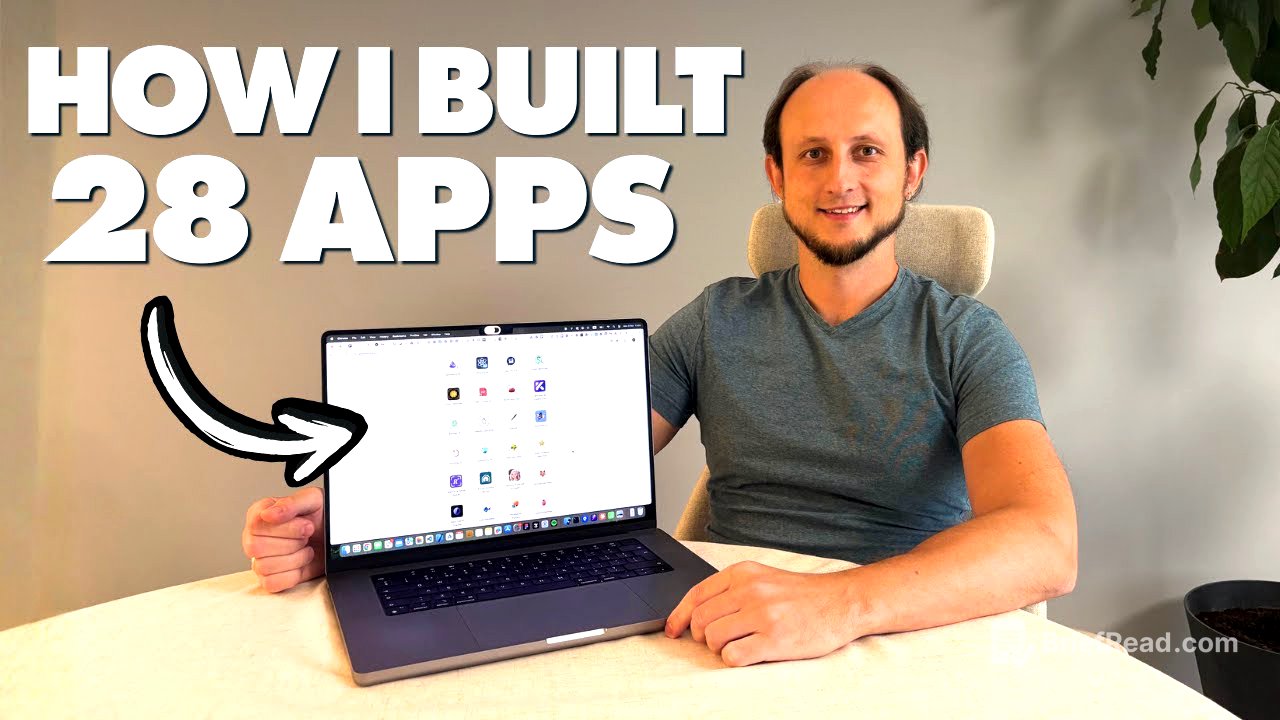
Max, a full-time developer, transitioned from struggling with a single app to creating 28 apps in eight months, increasing his monthly revenue from $200 to $10,000. He focuses on shipping apps quickly and moving on to the next project, proving that a portfolio of small, targeted apps can be successful. The video will cover his process for finding profitable app ideas, shipping apps rapidly, and a step-by-step guide to ideate, build, and launch an app in 48 hours.
Max's background [1:20]
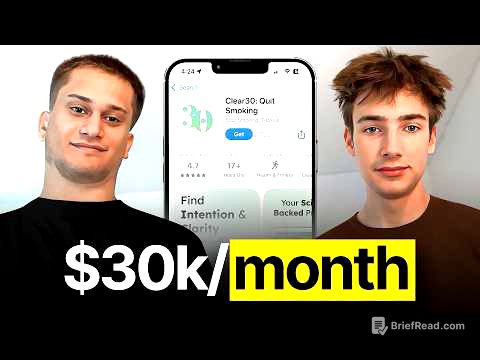
Max is an iOS engineer who, in his spare time, developed 28 mobile apps that generate $10,000 in monthly revenue with over 1,000 subscribers and 4,000-5,000 daily users across all apps. The majority of his income comes from four apps, each earning around $1,500 per month, illustrating the 80/20 rule. He initially struggled with a single "pet project" until discovering Adam Slles' approach of building and shipping simple, single-feature apps quickly.
How Max finds app ideas [3:04]
Max identifies app ideas by focusing on keywords that users search for in the app store when they have a problem. He uses the ASO tool Astro to research keywords within specific categories, looking for related keywords that target the same user group but solve slightly different problems, such as "physics AI," "chemistry AI," and "math AI" for students. He targets keywords with at least 20% popularity and 60-70% difficulty, and he verifies that top competitors are making at least $100-$200 per month to ensure market viability using tools like Sensor Tower.
Spot trending app ideas (The Hustle sponsor) [4:16]
The Hustle, a free daily email, is the sponsor of the video. It provides business news and stories to inspire building and launching business ideas.
The tool Max uses to spot ideas [5:29]
Max uses Astro to find app ideas by creating a temporary app profile and searching for relevant keywords, such as "tree identifier." He filters keywords based on popularity (at least 20%) and difficulty (around 70%). He looks for keywords like "wood identification" and assesses the potential revenue of competing apps in the App Store to determine if the idea is worth pursuing.
How Max ships fast [6:24]
Max's build process involves studying two to three competitors, focusing on the core feature related to the target keyword. He uses ChatGPT or Gemini to create a detailed implementation plan with specific UI/UX constraints. He reuses UI elements like custom buttons, views, onboarding screens, and paywalls across different apps, often copying 90% of the code to expedite development, sometimes shipping an app in just a couple of hours. He uses Figma to create app screenshots and icons, and he uses AI to generate app descriptions, ensuring all metadata is relevant to the selected keyword.
28APPS [7:46]
The video promotes Starter Story Build, which teaches how to build apps with AI and provides a framework for shipping apps repeatedly. A discount code "28APPS" is offered for 20% off the next Starter Story Build Boot Camp.
6-Step Building and Shipping process [8:56]
Max outlines his six-step process for taking an app from idea to the app store:
- Find strong keywords: Ensure a good popularity-difficulty ratio and verify that top apps are generating real revenue.
- Study competitors and define the core feature: Analyze top apps and choose a single core feature that solves the main user problem efficiently.
- Plan fast with AI: Use AI tools like Corser or Cloud to generate a clear development roadmap, feature breakdown, and UX structure.
- Build lean and ship quickly: Focus on shipping a clean MVP with only the necessary features to deliver value.
- Release and move to the next build: Let the app go and allow data to determine its potential.
- Return to winners and scale with ads: Revisit apps that show organic traction or retention, improve them, fix bugs, and add ads to enhance growth.
Tech stack and costs [10:55]
Max uses Flutter for app development, Fastlane for fast shipping, Corsur for AI coding, Firebase for backend services (authentication, database, website hosting), OpenAI and Gemini for image recognition and AI tasks, Mixpanel for analytics, and Astro and Fox Data for ASO. His monthly costs include $20 for Corsur, approximately $200 for OpenAI, $50 for Gemini, $5-10 for Firebase, and $10 for Astro, while Fastlane, Mixpanel, and Fox Data are used on free plans.
Final piece of advice [12:18]
Max advises not to be afraid of shipping apps. He recommends focusing on a single, bug-free feature, shipping the app, and letting users provide feedback while working on the next app, rather than spending time polishing and adding more features.
Pat's notes and reflections [13:05]
Pat reflects on Max's approach, highlighting the importance of building and shipping quickly, reusing components, and trying different ideas. He emphasizes the significance of developing a "shipping muscle" and the potential for stumbling upon a significant idea through this process. He reiterates that Starter Story Build helps individuals build this "shipping muscle" by guiding them through the process of idea generation, building, launching, and getting the app into the hands of real users.