TLDR;
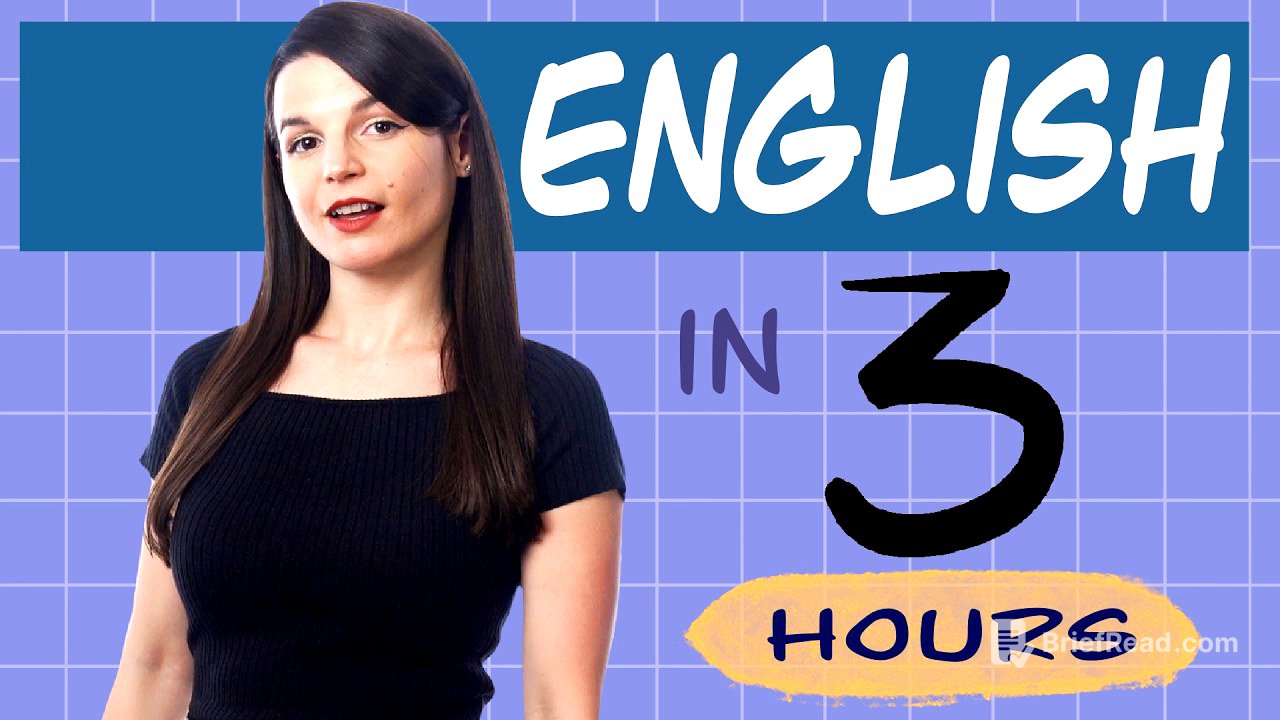
This YouTube video from EnglishClass101.com, hosted by Alicia, covers a variety of essential English topics. It includes travel phrases, compliments, motivation tips for English learners, grammar lessons on "by" vs. "until" and future/past tenses, vocabulary for the beach and family, common questions, bad habits, pronunciation tips, and insights into American culture and college life.
- Travel Phrases
- Compliments
- Motivation Tips
- Grammar: By vs Until
- Vocabulary: Beach, Family
Do You Have Any Recommendations? - 20 Travel Phrases You Should Know [0:20]
This chapter provides 20 essential travel phrases for English learners. These phrases are useful in various situations, such as asking for recommendations at a restaurant ("Do you have any recommendations?"), inquiring about prices ("How much is this?"), ordering items ("I'd like this"), and trying on clothes ("Can I try this on?"). Other phrases include asking if someone speaks English ("Do you speak English?"), making a reservation ("I have a reservation"), requesting water ("Water, please"), and checking if credit cards are accepted ("Do you take credit cards?"). The chapter also covers phrases for addressing order errors ("This isn't what I ordered"), requesting the menu ("Could we have the menu, please?"), asking for a discount ("Could you give me a discount?"), inquiring about vegetarian options ("Do you have any vegetarian dishes?"), asking someone to take a picture ("Could you take a picture of me, please?"), and stating allergies ("I'm allergic to..."). Additionally, it includes questions about Wi-Fi ("Is the Wi-Fi free?"), requesting a non-smoking seat ("I'd like to have a non-smoking seat, please"), asking for a map ("Could I get a map?"), requesting the check ("Could I have the check?"), asking for the location of the bathroom ("Where is the bathroom?"), and confirming the correct train ("Is this the train for...?").
I Love Your Cooking - 10 Compliments You Always Want to Hear [6:32]
This chapter presents ten compliments that people generally appreciate hearing. These include praising someone's cooking ("I love your cooking"), acknowledging a job well done ("Great job"), and complimenting their way with words ("You have a way with words"). Other compliments include telling someone they look gorgeous, noting their good taste in various areas (food, fashion, etc.), and appreciating their sense of humor ("You have a great sense of humor"). The chapter also covers compliments related to professional achievements ("Your resume is impressive"), inspiring qualities ("You make me want to be a better person"), and acknowledging someone as an awesome friend.
Imagine That One Day You Will Live in the United States - 10 Ways to Motivate Yourself When Learning English [14:50]
This chapter provides ten methods to stay motivated while learning English. These include imagining living in the United States, studying aspects of American culture, finding funny or enjoyable English words, making friends with English speakers, and watching YouTube videos of successful English learners. Additional tips include watching English movies and TV shows, reading English news articles and blogs, writing in an English journal, using flashcards, and thanking those who correct your English.
I'll Be at the Office By 7 PM - By vs Until [20:43]
This chapter explains the difference between using "by" and "until" in English. "By" marks a deadline for an action to finish, while "until" indicates a continuing situation or state that will change or stop at a certain point. The chapter includes example sentences to illustrate the correct usage of each word, such as "He has to find a new job by March" (deadline) and "I'm not going to go to bed until I finish this movie" (continuing action). It also notes that in some cases, both "by" and "until" can be correct but change the meaning of the sentence.
I Went to the Store This Morning, Also I Went and Got Coffee - 10 Words for Connecting Thoughts [35:27]
This chapter covers ten words used to connect thoughts and transition between ideas in both speech and writing. These words include "also" (to add information), "however" (to contrast), "on the other hand" (to present two sides), "still" (to show persistence despite a factor), "then" (for sequencing), "besides" (to indicate something else), "meanwhile" (to show simultaneous actions), "likewise" (to express a similar feeling), "instead" (to present alternatives), and "in addition" (to add a formal point).
Sunglasses - 20 Words You'll Need for the Beach [41:17]
This chapter provides 20 vocabulary words related to the beach. These words include "sunglasses," "beach," "swimming," "sun," "palm tree," "seashell," "swimsuit," and "ocean." Additional words covered are "lifeguard," "jet ski," "beach towel," "beach chair," "sand castle," "cooler," "tide," "tan," "snorkeling," "flip-flop," "sunscreen," and "bikini."
Personally, I Think That Pizza Is Amazing - 5 Sentence Patterns That You Can Use as a Beginner of English [51:42]
This chapter presents five sentence patterns for beginner English learners. These patterns include "Personally, I think that..." (to introduce an opinion), "What does... mean?" (to ask for the meaning of a word), "Can you tell me more about...?" (to request more information), "If it were up to me..." (to express a decision if it were yours to make), and "I feel like..." (to introduce a suggestion or express feelings).
To Travel Abroad - 10 Things to Do in the Summer in the United States [56:19]
This chapter lists ten activities to do in the summer in the United States. These include traveling abroad, relaxing at the beach, learning English with EnglishClass101.com, having a barbecue, partying all night, getting a tan, going hiking, working a part-time job, having fun with friends, and attending summer school.
Mother - 20 Must-Know Family Words [1:01:40]
This chapter covers 20 essential family-related vocabulary words. These words include "mother," "father," "sister," "brother," "grandmother," "grandfather," "uncle," "aunt," "cousin," "nephew," and "niece." Additional words covered are "wife," "husband," "parent," "child," "son," "daughter," "brother-in-law," "father-in-law," and "mother-in-law."
Maybe I'll Go Hiking Tomorrow - Simple Future Tense [1:07:21]
This chapter explains the simple future tense, focusing on the use of "will" and "going to." "Going to" is used for plans decided before the conversation, while "will" is used for decisions made at the moment of speaking. The chapter also notes that "will" has a lower certainty than "going to" and includes tips for more natural pronunciation, such as shortening "going to" to "gonna" and using contracted forms with "will."
He Brought a Towel and Sunglasses to the Beach - Simple Past Tense [1:21:26]
This chapter explains the simple past tense, covering when to use it and how to form statements. The simple past tense is used for actions that started and ended in the past, happened at a specific point in time, or were repeated actions in the past. The chapter details how to conjugate regular verbs (verb + ed) and notes the three different pronunciations of past tense verb endings (id, t, d). It also covers irregular verbs, which do not follow a simple rule and must be memorized.
Do You Like American Food? - 15 Questions You Should Know [1:33:59]
This chapter presents 15 common questions that English learners should know how to ask and answer. These questions include "Do you like American food?", "Have you been to the United States?", "How are you?", "How long have you been studying English?", and "How old are you?". Additional questions covered are "What did you say?", "What's this?", "What's your name?", "What's your phone number?", "When is your birthday?", "Where are you from?", "Where did you learn English?", "Where do you live?", "Where do you work?", and "Where is the bathroom?".
Your/You're - Bad Habits in English [1:42:14]
This chapter discusses common bad habits in English, including overusing filler words like "um" and "like," confusing "your" and "you're," and mispronouncing words. It also covers the misuse of "there," "their," and "they're," the incorrect phrase "could of," and the mispronunciation of "ask" as "ax." Additionally, it addresses overpronunciation and the misuse of "to" with "there."
Absolutely - 10 of the Hardest Words to Pronounce According to You Guys [1:52:10]
This chapter lists ten of the most difficult words to pronounce in English, according to viewer feedback. These words include "absolutely," "begrime," "breakfast," "colleague," "miscellaneous," "negotiation," "realm," "unfortunately," "vocabulary," and "world."
You Win - 10 Phrases That You Always Want to Hear [1:57:04]
This chapter presents ten phrases that people generally like to hear. These include "You win," "Here are the keys to your new car," "I brought you something special," "I miss you," and "Take a break, I'll do the cleaning today." Additional phrases covered are "The budget is unlimited," "There'll be a bonus at the end of the month," "You did a great job," "You look great today," "You were right," and "You're an excellent cook."
What's the Magic Word? - Things That Every American Kid Knows [2:01:59]
This chapter discusses things that most American kids know or have experienced. These include knowing the "magic word" (please), playing hide and seek, engaging in thumb wars, playing duck duck goose, using "eeny meeny miny moe" to choose someone, and playing truth or dare.
Good Evening Sir - Checking in at a Hotel in English [2:16:39]
This chapter provides essential phrases for checking into a hotel in English. Key phrases include "I have a reservation," "Could you spell your name, please?", "Is there a shop in this hotel?", "Is there any shampoo or conditioner in the room?", and "A wake-up call, please?". The chapter also covers asking about breakfast times and locations.
Passport Please - Navigating Passport Control in English [2:30:52]
This chapter provides essential phrases for navigating passport control in English. Key phrases include "Here you are," "Welcome to the United States," "How long will you be staying?", "Where will you be staying?", and "What's the purpose of your visit?". The chapter also covers appropriate responses to these questions.
Four Years - The College Experience in the United States [2:42:30]
This chapter discusses common aspects of the college experience in the United States. These include the typical four-year degree program, the "freshman 15" (gaining weight during the first year), partying, themed parties, and the use of red Solo cups. It also covers experimenting, sororities and fraternities.
What's the Main Difference Between British and American English? - Questions That We Have Been Asked [2:51:51]
This chapter addresses common questions about English, including the main differences between British and American English, the proper use of present tense versus progressive tense, how to pronounce the "th" sound, and the difference between present perfect and simple past tenses. It also touches on cultural aspects, such as why Americans wear shoes inside the house, and encourages learners to ask questions and engage in conversations.