
TLDR;
This lecture provides a detailed explanation of the nursing process, focusing on nursing diagnoses, planning, implementation, and evaluation. It emphasizes the importance of accurate data collection, problem prioritization, and collaborative care to achieve desired patient outcomes. The lecture also highlights the continuous nature of the nursing process and the need for ongoing evaluation and adaptation of care plans.
- Nursing diagnosis involves identifying health problems within the nursing scope.
- Planning includes prioritizing problems and setting short-term and long-term goals.
- Implementation is the execution of the care plan.
- Evaluation assesses the effectiveness of interventions and adjusts the plan as needed.
Introduction to Nursing Diagnosis [0:17]
Nursing diagnosis is the second step in the nursing process, following assessment. While physicians diagnose medical conditions, nurses identify health problems within their scope of practice. This involves analyzing data and determining what is normal versus abnormal in a patient's condition. Through nursing diagnoses, nurses aim to prevent, reduce, and resolve health issues using nursing interventions.
Four Categories of Nursing Diagnoses [1:52]
There are four categories of nursing diagnoses. The first is problem-focused diagnosis, which includes three parts: the problem (e.g., impaired physical mobility), the cause (e.g., pain), and the signs and symptoms (e.g., limited range of motion). The second is risk diagnosis, which identifies potential future problems and includes the problem and the cause (e.g., risk for deficient fluid volume related to persistent vomiting). The third is syndrome diagnosis, which involves a one-part diagnosis related to a specific condition or situation. The fourth is health promotion diagnosis, which focuses on improving health and also consists of one part (e.g., readiness for enhanced immunization status).
Components of Nursing Diagnosis [4:26]
A nursing diagnosis consists of three parts: the problem, the cause (etiology), and the signs and symptoms. For example, if a patient has a sleep pattern disturbance (problem) due to excessive caffeine intake (cause), this is evidenced by difficulty falling asleep and feeling tired (signs and symptoms).
Collaborative Problems [5:59]
Collaborative problems require a team effort to resolve potential complications that a nurse cannot manage alone. These issues necessitate consultation with a physician.
Planning: Setting Priorities [6:23]
Planning is the third step in the nursing process, involving the prioritization of health problems from most to least critical. Maslow's hierarchy of needs is used to rank these priorities, starting with physiological needs (e.g., breathing, pain management) and progressing to safety, love and belonging, self-esteem, and self-actualization.
Establishing Outcome Criteria: Short-Term Goals [8:29]
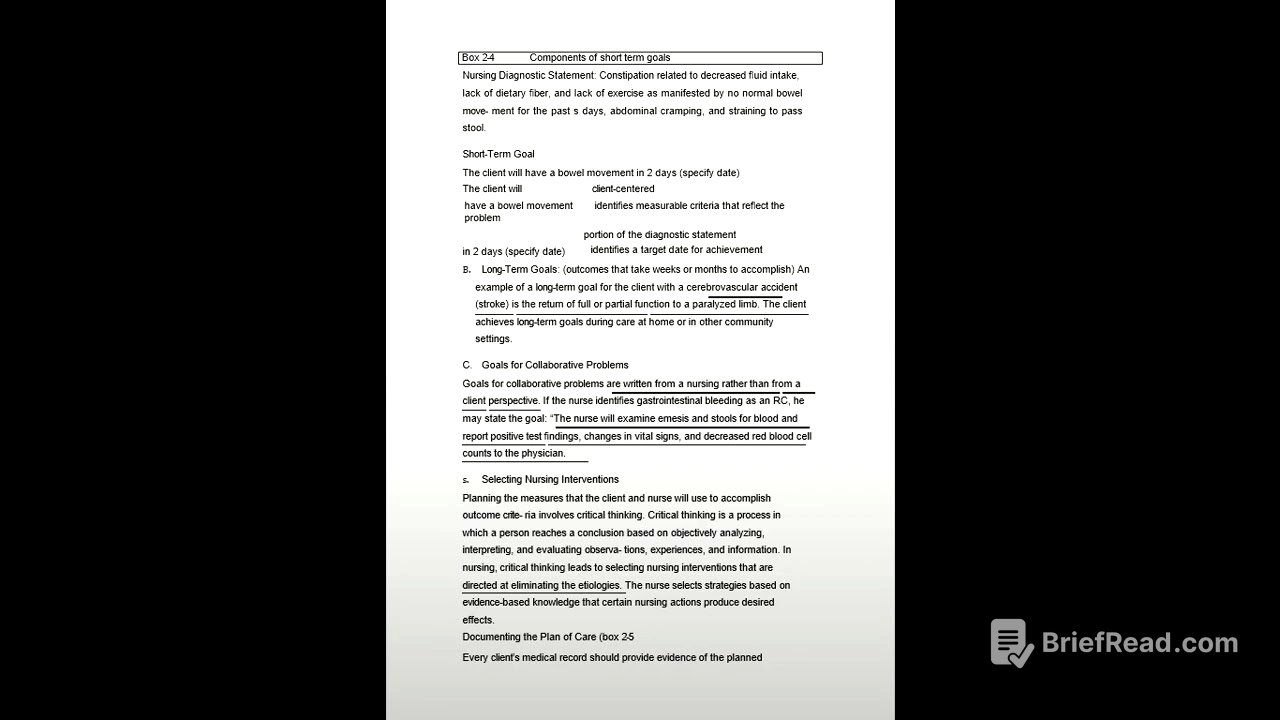
Establishing outcome criteria involves setting short-term and long-term goals. Short-term goals are achievable within a few days to a week and should be client-centered, measurable, attainable, and realistic. For example, a short-term goal for a patient with constipation related to decreased fluid intake could be to have a bowel movement within two days.
Establishing Outcome Criteria: Long-Term Goals [10:44]
Long-term goals take weeks to months to achieve, such as rehabilitation for a patient with a stroke. These goals often require collaborative efforts and continuous monitoring.
Selecting Nursing Interventions [11:47]
Selecting nursing interventions requires critical thinking to choose appropriate actions based on evidence-based practice and knowledge. These interventions should lead to the desired outcomes. Documenting the nursing care plan is also essential. Nursing orders must be clear and specific, detailing what, where, and how the intervention should be performed. Communication with the patient, family, and healthcare team is crucial for achieving comprehensive care. The care plan is a permanent part of the patient's medical record.
Implementation [13:44]
Implementation is the fourth step in the nursing process, where the care plan is put into action. This involves executing the planned interventions meticulously.
Evaluation [14:37]
Evaluation is the fifth and final step, assessing whether the interventions achieved the desired outcomes. This involves discussing the patient's progress with the patient and family. The nursing process is ongoing, requiring continuous evaluation and adjustments to improve patient health.
Outcomes of Evaluation [15:28]
There are three potential outcomes of evaluation. First, the patient responds and achieves the goal, indicating an effective care plan. In this case, the nursing orders are discontinued. Second, the patient shows some improvement but has not fully reached the goal, suggesting that the care may need clarification or the patient's response was less than expected. The action here is to refine the orders and continue care. Third, the patient shows no progress, indicating potential issues with the diagnosis, new problems, unclear information, or ineffective interventions. The action is to review the problems, add new instructions, and implement more effective measures.
Guidelines for Using the Nursing Process [17:23]
The nursing process is used throughout nursing studies and practice. Guidelines include collecting and organizing data, identifying normal versus abnormal findings, and ensuring that the care plan addresses the patient's problems effectively. It is important to discuss the care plan with the patient, family, and team, and to monitor and compare the patient's responses before and after interventions. The care plan should be adjusted based on the patient's needs. The nursing process is continuous and repeated until the goals are met.