TLDR;
This video explores the philosophy of Yin and Yang, an ancient Chinese concept, and its relevance to navigating life's challenges and finding balance. It emphasizes the interconnectedness of seemingly opposite forces, such as good and bad, and how understanding this duality can lead to a more harmonious and fulfilling existence. The discussion covers practical applications of Yin and Yang in daily life, offering wisdom for responding to adversity, fostering personal growth, and achieving a balanced perspective.
- Yin and Yang is a fundamental law of the universe, representing paired opposites that are interconnected and interdependent.
- Understanding Yin and Yang can help individuals respond to challenges with balance and perspective.
- Applying Yin and Yang principles can lead to a more harmonious and fulfilling life.
Introduction [0:01]
The speaker opens with a prayer and expresses gratitude for the opportunity to continue their study, acknowledging the vastness of knowledge and the current challenging times marked by both the pandemic and natural disasters. He encourages viewers to approach these difficulties with introspection, repentance, and a commitment to improvement, both in their personal lives and in their relationship with the environment. The speaker suggests viewing these challenges as warnings, tests, or even consequences, each requiring a different response: reflection, repentance, or perseverance.
The Law of Polarity: Yin and Yang [4:55]
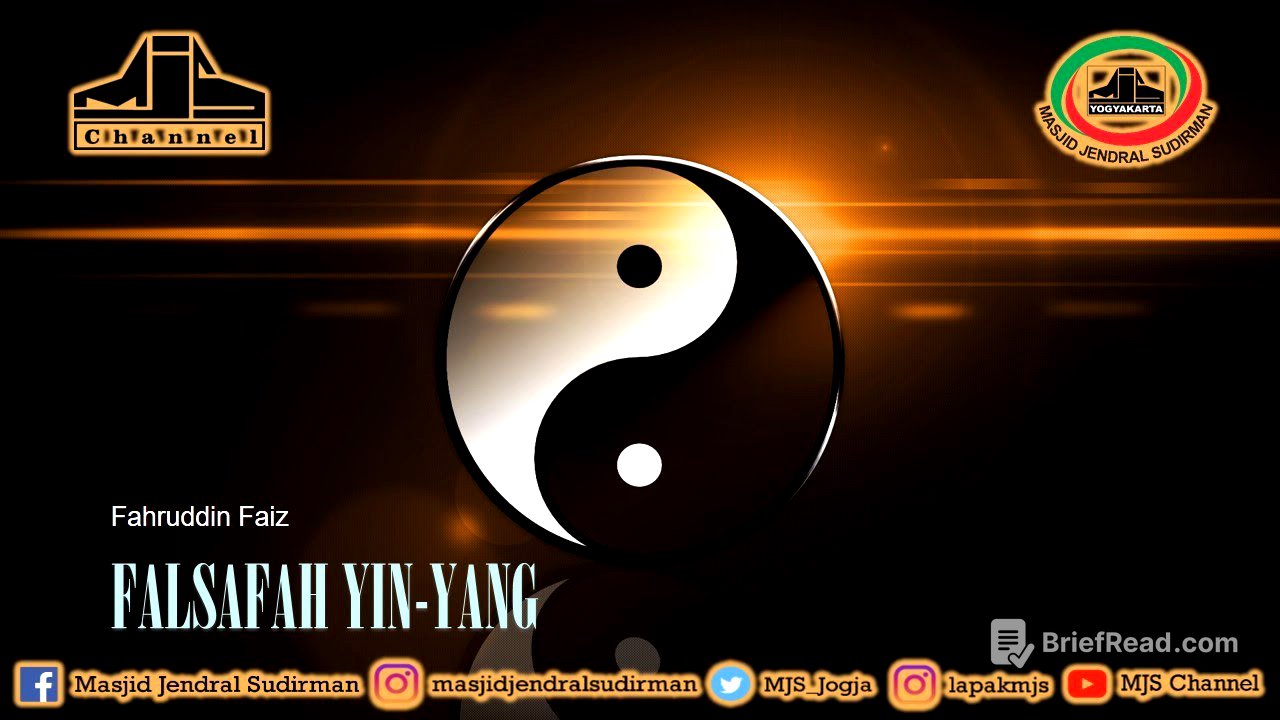
The discussion transitions to the main topic: the Law of Polarity, specifically the concept of Yin and Yang. Originating from ancient Chinese philosophy, possibly as early as the 14th century BCE, Yin and Yang represents the idea that everything in life has two sides that are different, complementary, interdependent, influential, and mutually containing. Yin is associated with passivity and Yang with activity, illustrating the dualistic nature of existence. This concept highlights the importance of balance and dynamism in life, where opposing forces interact to create completeness and progress.
Understanding Yin and Yang [10:10]
The speaker explains that Yin and Yang is a universal law of paired opposites, where each side is different, complementary, interdependent, influential, and mutually containing. In practice, Yin and Yang can be understood as vital energy or as concrete objects. Drawing from the teachings of Lao Tzu's Tao Te Ching, the speaker illustrates how concepts like beauty and ugliness, good and bad, rely on each other for definition. He emphasizes that recognizing this interdependence can foster gratitude and shift perspectives on life's difficulties.
The Wisdom of Yin and Yang [25:47]
The speaker shares insights from Tao Te Ching and Zhuangzi, emphasizing the need for balance between Yin and Yang to avoid stagnation or burnout. He introduces the concept of "Wu Wei," living in harmony with the natural flow of life, without artificiality or unnecessary actions. This involves aligning with the rhythms of the universe and living authentically.
Principles of Living in Harmony with Yin and Yang [36:08]
The speaker outlines several principles for living in harmony with Yin and Yang: balance, justice, simplicity, flexibility, openness, and joy. These principles encourage individuals to seek equilibrium in their lives, act fairly, live simply, be adaptable, remain open to new perspectives, and cultivate joy by appreciating life's blessings.
Stories Illustrating Yin and Yang [47:07]
The speaker shares two folk tales to illustrate the principles of Yin and Yang. The first story tells of two intellectual friends, Yin and Yang, who initially disagree but come to understand each other after dedicating 40 years to studying each other's teachings. The second story tells of an old farmer and his horse, illustrating how seemingly good or bad events can lead to unexpected outcomes, emphasizing the dynamic and dialectical nature of life.
Wisdom from Yin and Yang: Part 1 [1:01:54]
The speaker presents a series of wisdom principles derived from Yin and Yang philosophy. These include recognizing that truth and error coexist, avoiding excess in even good things, understanding that giving leads to receiving, finding blessings in adversity, and recognizing that praise can lead to complacency while criticism can inspire growth.
Wisdom from Yin and Yang: Part 2 [1:25:36]
The speaker continues with more wisdom principles, including that true freedom lies in understanding boundaries, dominance leads to the growth of its opposite, greater hope implies greater fear, and the world and the afterlife are interconnected. He emphasizes the importance of balance and moderation in all aspects of life.
Wisdom from Yin and Yang: Part 3 [1:42:11]
The speaker shares additional wisdom principles, including that increased knowledge leads to the realization of how much one doesn't know, the discovery of truth can lead to tragedy, and human perfection lies in accepting imperfection. These principles highlight the paradoxical nature of life and the importance of humility and acceptance.
Wisdom from Yin and Yang: Part 4 [1:52:26]
The speaker presents final wisdom principles, including that victory carries burdens while defeat offers freedom, happiness arises when one stops seeking it, avoiding pain often involves experiencing it, and excessive control leads to chaos. These principles encourage a balanced perspective and acceptance of life's inherent dualities.
Connecting Yin and Yang with Nusantara Wisdom and Islamic Teachings [2:00:00]
The speaker connects Yin and Yang with Nusantara wisdom and Islamic teachings, citing Javanese philosophies and verses from the Quran and Hadith that reflect similar principles of balance and interconnectedness. He concludes by summarizing the key points of the discussion and expressing hope that the insights shared will bring benefit and blessings to the viewers' lives.