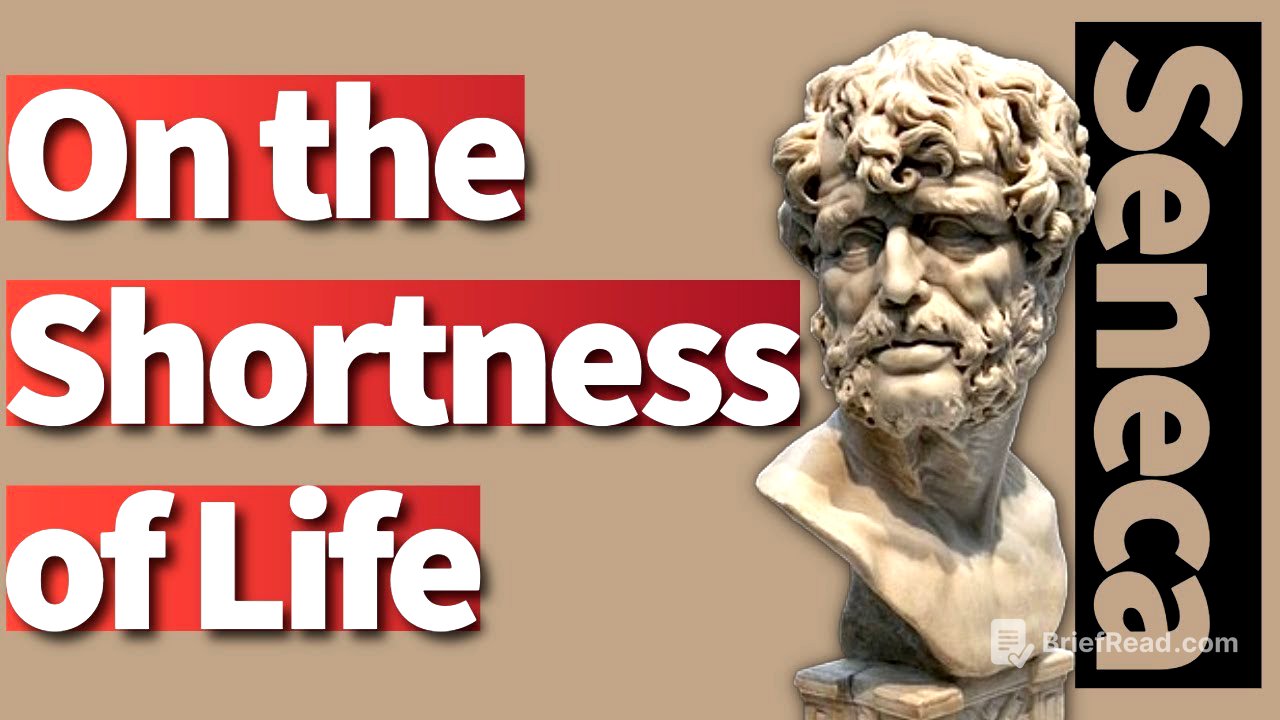
TLDR;
This video discusses how people often complain about the shortness of life, but in reality, they waste much of their time. It explores how individuals become entangled in various pursuits, driven by greed, ambition, or societal pressures, leaving them with little time for themselves. The video highlights the importance of using time wisely, living in the present, and prioritizing personal well-being over external validation. It suggests that true fulfillment comes from self-awareness, philosophical pursuits, and meaningful connections, rather than chasing fleeting pleasures or societal recognition.
- People waste time on unnecessary things.
- True fulfillment comes from self-awareness.
- Live in the present.
Introduction: The Perception of Time [0:01]
Many people, including wise individuals, lament that life is too short and time passes quickly. A doctor once said that life is short, but art is long. Even Aristotle complained that animals have longer lives than humans, who have grander purposes but less time. However, the issue isn't the lack of time, but how we waste it on trivial matters, excessive comforts, and meaningless activities. Only at the end of life do we realize how much time has slipped away.
The Illusion of a Short Life [1:16]
We don't have a short life; we make it short by wasting time. Just as wealth diminishes in the hands of the unwise but grows with careful management, life seems long when lived purposefully. We blame nature, but it has given us enough time if we use it wisely. People waste energy on greed, useless tasks, alcohol, laziness, political ambitions, chasing profits, military obsessions, and flattering the powerful. Many chase wealth or complain about their finances, while others wander aimlessly, never content, and realize too late that death is near.
The Impact of Bad Habits [2:48]
We only live a small part of our lives, with the rest being mere time, not genuine living. Bad habits trap people, preventing them from seeing the truth and reclaiming their true selves. Even when they find peace, restlessness remains, like waves after a storm. They can never escape their desires. Those who seem fortunate are often suffocated by their own happiness. Many find their wealth burdensome, and some exhaust themselves trying to display their talents. Some are so consumed by crowds that they have no time for themselves, always helping or judging others but neglecting their own needs.
The Importance of Self-Reflection [4:28]
Even those whose names are remembered are often busy pleasing others, never looking at themselves. People complain about powerful figures not giving them time, but they don't have time for themselves. Those who neglect themselves shouldn't complain about others. Great individuals have noticed you, listened to you, and allowed you to accompany them, even if superficially. However, you have never looked at yourself or spoken to yourself.
The Absurdity of Prioritizing Trivialities
Even the brightest minds would struggle to fully grasp the extent of human error in how we value time. People fiercely protect their property but allow others to encroach on their lives, even willingly giving away their time. They are stingy with their possessions but extravagant with their time. An old man nearing 100 should reflect on how much time was taken by lenders, women, officials, clients, marital disputes, punishing servants, and aimless errands. Illnesses and idle time further diminish the years, revealing how little time was truly his own.
Living Authentically [7:15]
Reflect on when you had firm intentions, days lived as you wished, and moments of true self-ownership. How often were you truly at peace? How much time was stolen by others without your awareness? How much was wasted on pointless sorrow, foolish joy, greed, or societal pressures? You'll realize you aged quickly because you lived as if you would live forever, forgetting your mortality and squandering time as if it were endless. The day you give away could be your last.
The Futility of Delaying Fulfillment [8:21]
People act cautiously in the face of danger but live as if they will never die. Many plan to relax at 50 or retire at 60, but there's no guarantee of a long life. It's foolish to save the best part of life for last, only to start living when nearing death. Even powerful people long for leisure and wish to escape their responsibilities. Augustus, despite his divine blessings, constantly sought rest and relief from public duties, finding solace in the mere hope of future leisure.
The Cost of Ambition and Power [10:43]
Augustus valued leisure so much that he rejoiced in the thought of it, even when it was unattainable. He knew his fame came with struggles and hidden fears, battling enemies, allies, and relatives. He fought across lands and seas, enduring constant threats and tensions. Similarly, Marcus Cicero, caught between enemies and unreliable friends, struggled to manage the state and ultimately failed to find peace in good or bad times.
The Illusion of Freedom [13:00]
Cicero lamented his past life and despaired for the future, calling himself half a prisoner. A wise person would never use such a degrading term, remaining free and in control, above fate. Livius Drusus, despite his courage and intelligence, faced constant strife and never found respite, ultimately cursing his restless life. It's uncertain if he committed suicide, but his death was seen as timely.
The Brevity of Life and the Trap of Bad Habits [15:23]
It's pointless to name others who appeared happy but hated their lives, their complaints changing nothing. Life, even if it lasts a thousand years, will seem short if bad habits consume your time. Time, which can be extended with wisdom, slips away unnoticed because you don't seize it or try to slow it down, treating it as worthless. Those who waste their lives on alcohol and lust are the worst off, lacking any noble purpose.
The Futility of Constant Activity [17:07]
Others may chase false glory but at least have some right thinking. The truly shameful are those consumed by eating, drinking, and lust. They spend their time scheming, fearing, flattering, borrowing, and attending parties, never finding a moment to breathe. No task can be done well with a divided mind; everything remains superficial. For the constantly busy, living becomes the least important task, yet it is the most difficult.
The Art of Living and Dying [18:10]
Teachers for other skills are abundant, and even children can master some tasks, but learning how to live takes a lifetime. Surprisingly, learning how to die also takes a lifetime. Many great individuals abandoned wealth and pleasure to focus on living correctly, yet most admitted they hadn't learned by the time they died. A truly great person doesn't waste time, using every moment for themselves, free from external control.
The Value of Time and the Trap of External Influences [19:32]
Those with excessive external influences always lack time. Many successful people lament the impossibility of living amidst crowds and troubles. Those who call you to them actually distance you from yourself. Consider how much time is taken by lawsuits, candidates, worried heirs, or those who feign illness for attention. Calculate your days and see how few are truly your own.
Living in the Present [21:27]
Someone eager to leave a high position constantly asks when the year will end. Another, thrilled to host games, asks when they will be free. A lawyer surrounded by crowds longs for vacation. Everyone pushes life forward, restless and troubled by the present. But those who keep their time for themselves, living each day as their last, neither fear nor long for tomorrow. They have seen and lived everything, and fate can take nothing from them.
The Illusion of Long Life [22:08]
Don't assume someone has lived long just because they have white hair or wrinkles. They haven't lived long, just existed for a long time. A journey isn't long if it's filled with storms and aimless wandering; it's just prolonged wandering. It's astonishing how people readily give away their time without considering its value. They joke about life's most precious resource because it's invisible and seems cheap.
The True Value of Time [23:18]
People gladly accept pensions and rewards, exchanging their labor for them, but they don't value their time, spending it as if it were worthless. Yet, when faced with death, they beg doctors for more time or offer everything to avoid execution. This reveals the truth of their thinking. If everyone could see their remaining years as clearly as their past ones, they would be horrified and use every moment wisely.
The Importance of Managing Time [24:09]
It's easier to manage a certain amount of time. We should focus on managing what can end at any moment. It's wrong to think people don't value time; they often offer to give a piece of their age to loved ones, unknowingly harming themselves and giving nothing of real value. They don't realize what they're losing, so they don't grieve the loss.
The Irreversible Nature of Time [25:03]
No one can bring back the past or return you to yourself. Life moves forward, never stopping or turning back, silently passing. As a result, you become entangled in life, and time slips away, eventually leading to death. What could be more foolish than those who boast of their foresight, spending their lives trying to improve it but ultimately wasting their lives planning?
The Danger of Procrastination [26:06]
Putting things off is the greatest waste of life, sacrificing each day and living only for tomorrow. The real problem is that we lose today in anticipation of tomorrow. They plan what's in fate's hands and neglect what's in their control. What are they looking at? What goal are they chasing? The future is uncertain; start living now.
Seizing the Present Moment [26:54]
Listen to our greatest poet, who speaks as if divinely inspired: "The best day of life flees first for the wretched." Why wait? Why waste time? If you don't seize time, it will pass, and even if you do, it will still pass. Use time's swiftness to your advantage, drinking from the flowing river that won't always be there. The poet refers to the best day, not the best age.
The Fleeting Nature of Time and the Onset of Old Age [27:41]
Why are the greedy so careless when time is fleeting, letting months and years accumulate? The poet speaks of today, the day that is passing. There's no doubt that the best day passes first for the wretched, the entangled. Old age arrives before they realize it, catching them unprepared, still childish in mind.
The Illusion of Control and the Reality of Time's Passage [28:22]
Old age comes suddenly, without warning, and you don't realize it's approaching. Like travelers lost in conversation or books, they don't notice their destination approaching. Life's journey moves quickly, whether you're awake or asleep, and those who are entangled only realize it when it's over.
The Importance of Confronting Bad Habits [28:55]
If I were to divide my argument into sections and provide proof, I could offer many points to show that the lives of the entangled seem short. However, Fabianus, a true philosopher of old, said that we should fight our passions not with logic but with direct confrontation, defeating the enemy with full force, not small blows. Bad habits must be eradicated, not gradually diminished.
The Three Divisions of Time [29:45]
Life is divided into three parts: the past, the present, and the future. The present is brief, the future is uncertain, and the past is secure because fate has no power over it and it cannot be undone. But the entangled lose this, having no time to reflect on their past, or if they do, they recall things they'd rather forget.
The Value of a Clear Conscience [30:42]
No one looks back on their past with joy unless all their actions are right in their own eyes. You can't deceive your own truth. Those who fear their memories are those who sought to advance through greed, belittled others in arrogance, lacked control in victory, cheated in deceit, looted others' possessions, or wasted time.
The Security of the Past [31:18]
Our past is most precious because it's free from danger and fate's control. Neither illness nor any other trouble can affect it. That time will never return, nor can anyone steal it; it is ours forever. In the present, we have only one day, received minute by minute, but all past days can return in memory. This is what the entangled have no time for.
The Power of a Tranquil Mind [32:06]
Only a mind that is calm and free from worry can wander through every stage of life. Those who are always entangled, like those caught in a game of chance, can't look back. Their lives fall into a pit, and like a bottomless vessel, no amount of water stays. If we don't have a place to store time, no amount of time will suffice.
The Elusive Present [32:42]
The present is so short that some don't even notice it because it's always moving, quickly advancing and disappearing before it arrives, never stopping. Like the sky or stars, it never stays in one place. Therefore, the entangled are only connected to the present, and even this is too short to grasp and is taken from them as they engage in pointless entanglements.
The Desire for Longevity [33:21]
If you want to know why these people don't live long lives, look at how desperately they desire it. The old and weak pray for a few more years, underestimating their true age, deceiving themselves as if they could deceive fate. But when illness reminds them of their mortality, they die terrified, as if being dragged from life rather than leaving willingly.
The Regrets of a Wasted Life [33:54]
They then say they were foolish and never truly lived, promising to live peacefully if they recover. They realize the things they worked for were useless, and all their running was in vain. But for those whose lives are free from business, life is always long enough. No time is wasted, scattered, left to fate, lost in carelessness, or spent on pointless generosity or idle talk.
The Definition of Entanglement [34:58]
Perhaps you want to know who I consider entangled. I'm not just referring to those who are removed from court when dogs arrive, those who are crushed in crowds, or those whose social duties take them from their homes to others' doors. Or those whose time is wasted on auctions and chasing dishonest gains. Some are entangled even in their leisure time, in their farmhouses, beds, or solitude, never content with themselves.
The Illusion of Leisure [35:53]
Their lives should be called pointless entanglement, not leisure. Do you consider someone leisurely who meticulously arranges their Corinthian bronzes, spending most of their day on old pieces of iron? Or someone who wastes time watching boys wrestle? Or someone who pairs animals based on age and color? Or someone who pays for the care of new athletes?
The Absurdity of Vanity [36:29]
Do you consider leisurely those who sit for hours at the barber, getting a nightly haircut, debating every hair, setting tangled hairs, or trying to bring thin hairs to the forehead? They become enraged if the barber makes a mistake, as if cutting the hair of a true man. They are furious if the hair is cut wrong or not set well.
The Prioritization of Appearance over Substance [37:02]
Which of these would rather see their country in bad shape but not their hair? Who values their hairstyle more than their safety? Who wants to appear stylish rather than respectable? Do you consider leisurely those who divide their time between combs and mirrors?
The Pointlessness of Trivial Pursuits [37:32]
What about those who create, listen to, or learn songs, changing their natural voices in the strangest ways? Those who constantly tap their fingers on the table, humming tunes, even during serious or sad conversations? This isn't leisure, just pointless time-wasting. And it's wrong to call their eating and drinking leisurely.
The Extravagance of Lavish Living [38:04]
Look at how they arrange their silver dishes, correct the servants' attire, and stress over how the cook prepared the pig. Servants run around, and young boys clean up the spit of drunks, all so people will see them as having great taste and style. These pointless matters are so intertwined in their private lives that they can't eat or drink without showing off.
The Loss of Self-Awareness [38:50]
I don't consider leisurely those who ride in palanquins or swings, always ready for a stroll as if it were a necessity. Others must tell them when to bathe, swim, or eat because their lazy minds can't trust themselves to know if they're hungry. I heard that one such man, who doesn't do these things himself, asked, "Am I sitting down?" after being bathed and placed in a palanquin.
The Depths of Self-Neglect [39:30]
If someone doesn't know if they're sitting, do they know if they're alive, seeing, or at leisure? I don't know whether to laugh or grieve at such people. Some truly forget things, and others pretend to forget. They consider some bad habits as signs of their fate. It seems only the poor and simple truly know what they're doing.
The True Meaning of Leisure [40:05]
Can you still accuse mime artists of mocking luxury? In reality, there are far more bad habits in this era than they show, and it seems the mimes only show a little. If someone is so immersed in luxury that they must ask if they're sitting, they can't be called leisurely but rather sick or perhaps dead. Those who are truly at leisure know their condition, but those who are half-alive don't even know the state of their bodies.
The Futility of Mindless Activities [40:50]
How can they be masters of any time in their lives? It's boring to name everyone who spends their lives playing Ludo or ball, or sitting in the sun. These people aren't at leisure; their fun requires hard work. Just as no one believes those who waste time on useless studies are at leisure. Now, such people are abundant even in Rome.
The Obsession with Useless Knowledge [41:25]
This habit was common among the Greeks, who needed to know how many sailors Alcis had, whether the Iliad or Odyssey was written first, and whether they were by the same author. Such pointless matters are useless to know and boring to share. Now, this zeal for knowing useless things has spread to Rome. I recently heard someone recounting which Roman general did what first.
The Pointlessness of Historical Trivia [42:06]
Dullius won the first naval battle, and Curius Dentatus first included elephants in a celebration. These things, though not truly honorable, are at least examples for the country. Such matters may not help us, but we enjoy them in our pursuit of useless information. We can forgive those who spend time figuring out who first convinced the Romans to board ships.
The Absurdity of Historical Obsessions [42:53]
It was Claudius, also called Codex, because the thing that joins pieces of wood was called Codex in ancient times. This is why law books are called Codices, and today, the ships that bring goods on the Tiber River are called Codicariae. It's also fine to know that Valerius Corvinus first conquered Messana, and he was the first in the Valerii family to receive the name Messana, which later became Messala in common speech.
The Dangers of Glorifying Cruelty [43:22]
Perhaps you also want to know that Lucius Sulla first showed open lions in the circus, while at other times they were kept in chains, and King Bocchus sent spearmen to kill them. This can also be forgiven. But is there any benefit in knowing that Pompey first staged a battle of 18 elephants in the circus, in which innocent people were forced to fight them?
The Depravity of Power and the Illusion of Greatness [44:04]
That king, who was considered very kind, saw devising new ways to kill humans as a great spectacle. People won't just die; they must be torn to pieces and crushed by animals. Such acts are best forgotten, or someone might try to do something even worse. See how much wealth blinds human understanding. He thought himself above the laws of nature when he threw so many poor people to wild animals, pitting different animals against each other, and spilling so much blood before the people of Rome, whom he later gave to each other.
The Vanity of Earthly Achievements [44:56]
But later, he himself was deceived and killed by the smallest slave, and then he understood that his great name was just a show. Now, back to the real point, and to show how some people waste time on useless matters, the same man was saying that when Metellus defeated the Carthaginians in Sicily, he led 120 elephants alone before his chariot in his victory celebration.
The Futility of Historical Debates [45:15]
And Sulla was the last Roman to extend the Pomerium, which in ancient times was only extended when Italian territory was won, not external territories. Is it good to know this, or to know that the Aventine Hill, as he said, is outside the Pomerium, either because common people once moved there or because Remus didn't see good omens there, and countless other things that are either lies or very close to lies?
The Importance of Personal Growth [45:52]
Assume they're saying everything correctly. Assume they're guaranteeing the truth. How will this reduce anyone's faults? How will it lessen bad habits? Who will become more free, more just, more big-hearted from this? Our Fabianus used to say that it often seems better not to do any research than to get caught up in such pointless messes.
The Value of Philosophy [46:22]
Only those who make time for philosophy are truly at leisure. Only they truly live because they pay attention not only to their own lives but also add every era to their lives. All the years that have passed before them also become their own. If we aren't very ungrateful, we must admit that all the great people paved the way for us. Through the efforts of others, we reach things that were once in darkness and are now in light.
The Freedom of Philosophical Pursuits [47:02]
We haven't been excluded from any era. We can go into each one, and if our minds can rise, we can escape human weakness and wander far. We can debate with Socrates, doubt with Carneades, embrace solitude with Epicurus, conquer human nature with the Stoics, and exceed their limits with the Cynics.
Embracing Immortality Through Philosophy [47:36]
When nature allows us to be partners of every era, why not abandon this short and fleeting time and give ourselves wholeheartedly to that past time that is infinite and can always be shared with everyone, especially those who were better than us? Those who rush through social duties every day, troubling themselves and troubling others, when they complete their mad dash and knock on every door, going to distant homes to offer meaningless greetings, think of how many they truly meet in such a large city where everyone is entangled in different desires.
The Superiority of Philosophical Companionship [49:12]
How many people don't allow them to meet because of sleep, their own fun, or rudeness? How many hours do these people wait, and the person just makes an excuse and runs away? How many people leave through the back door to avoid the crowd, as if meeting face-to-face would be more rude, more deceitful? How many people, still sluggish after a night of drinking, offer a mere greeting and must be reminded of their name, while the poor person broke their sleep to be present early in the morning?
The Benefits of Philosophical Friendship [49:28]
In reality, those who want to make Zeno, Pythagoras, Democritus, and all the other great philosophers, Aristotle and Theophrastus, their friends are more useful. None of these is ever too busy to meet you. None lets you leave without joy and satisfaction, and none sends you back empty-handed. These people are available day and night.
The Enduring Wisdom of the Philosophers [49:46]
None of them will force you to die, but all will teach you how to die. They won't end your years but will give you their years. There's no harm, no danger, no expense in being friends with any of these. You can take whatever you want from them. If you don't take it, it's your fault, not theirs. Think of how good a life and how great an old age that person will have who has made such people their friends.
Choosing Your Philosophical Ancestry [50:42]
They will have friends from whom they can seek advice on every question, big or small, who will tell them the truth every day without insult and praise them without flattery, who will show them how to become as they themselves want to become. We often say that we didn't have a choice in choosing our parents; we received them by fate. But we can decide whose children we want to become.
The Immortality of Philosophical Works [50:55]
There are families of the wisest people in the world. Choose which family to join, and you'll receive not just their name but also their real treasure, and this is a treasure that increases the more you share it. These people will show you the path to immortality and take you to such heights that no one can fall. This is the only way a short life can become long, even immortal.
The Enduring Legacy of Philosophy [51:28]
Names and monuments, whatever people have built for themselves, all quickly fade away. Nothing survives time, but nothing can harm the works created by philosophy. No era can erase them, and no deficiency can diminish them. Every succeeding era will make them greater because jealousy only occurs with nearby things; distant things are praised openly.
The Boundless Life of the Philosopher [52:00]
Therefore, the life of a philosopher is very long and expansive. They aren't bound by the same limits as others. They are the only ones who are free from human limitations, and every era serves them as if they were a god. The time that has passed, they remember. The time that is now, they live. The time that will come, they anticipate. By joining all these together, they receive a truly long life.
The Shortcomings of a Distracted Life [52:35]
Those who don't remember their past, who ignore their present, and who fear the future have a very short and troubled life. When these people reach the end of their lives, they realize too late that they wasted all their time without any real work. And sometimes, when they pray for death, it doesn't mean they found life long. Their foolishness makes them restless, and they run toward the things they fear.
The Illusion of a Long Day [53:20]
They often desire death because they fear it. And it can't be said that their lives are long just because the day seems long to them or time passes slowly until dinner because as soon as their busy lives end, they become restless about what to do next. They don't know any good way to spend their leisure time or any way to pass the time.
The Restlessness of the Idle Mind [53:44]
Therefore, they're always looking for some other work, and the time in between seems boring to them. Just like when a show is about to come on or an exhibition or fun, and they want all the days in between to pass quickly. Any delay in what they're waiting for seems very heavy to them. But the time of real fun is very short and passes quickly, and this is also due to their own fault.
The Futility of Fleeting Pleasures [54:16]
They run from one pleasure to another and can never settle on one thing. Their days aren't long but rather joyless. On the other hand, the nights they spend drinking or on wrong paths seem very short to them. This is why poets have also said upside-down things in which they show that Jupiter has so much fun in love that he doubles the night.
The Dangers of Justifying Bad Habits [54:47]
In reality, these are all things that promote our inner bad habits, when we try to justify our mistakes using God as an excuse. Do those nights for which they squander so much not seem short to them? They lose the day waiting for the night, and they lose the night fearing the morning. Their fun is also filled with fear and restlessness.
The Fleeting Nature of Happiness [55:12]
And when they're most happy, fear comes to mind about how long it will last. This is the thought that has frightened even kings with their power and made them not enjoy their fate as much as they feared its end. When the most arrogant king of Persia stands his army in the field and can't count them but must measure them, he weeps that none of these will be alive in 100 years.
The Impermanence of Power and the Futility of Worry [56:09]
But the one who was weeping himself became the cause of their destruction, destroying some in the sea, some on land, some in battle, some while fleeing, in a very short time. He was worried about their long lives. And think of why their joys are also restless. Because they don'