
TLDR;
This video serves as an introduction to forces, explaining what forces are, how they are measured, and the different types of forces. It covers the concept of force, its measurement in Newtons, and the relationship between force, mass, and acceleration as described by Newton's second law of motion. The video also provides practical examples and problem-solving techniques to calculate force, mass, and acceleration, and introduces the two main categories of forces: contact and non-contact forces.
- Force is defined as an invisible strength or power that causes objects to move, stop, change direction, or alter shape, and is measured in Newtons.
- Newton's second law of motion (F=ma) is explained, detailing the relationships between force, mass, and acceleration, including direct and inverse proportionality.
- The video introduces the "GFSA" method (Given, Ask, Formula, Solution, Answer) for solving force-related problems and provides examples.
- Two types of forces are defined: contact forces (require physical touch) and non-contact forces (act at a distance).
Introduction to Forces [0:00]
The lesson introduces the concept of forces, explaining that understanding forces is crucial not only for athletes but also for engineers, doctors, lawyers, teachers, and policemen. Force is defined as an invisible strength or power that, when applied to an object, can cause it to start moving, stop, change its path, or alter its shape. It is measured in Newtons (N) using a spring balance. A Newton is the force required to accelerate a 1 kg object at a rate of 1 meter per second squared.
Newton's Second Law of Motion [4:02]
The video explains that the unit of force, Newton, is derived from Isaac Newton's second law of motion, which states that force equals mass times acceleration (F = ma). Mass is a measure of how heavy an object is, with kilograms (kg) as its unit, while acceleration measures how quickly an object changes its velocity, with meters per second squared (m/s²) as its unit. The relationship between these quantities involves direct and inverse proportionality. Mass and acceleration are inversely proportional, meaning a heavier mass results in slower acceleration, and vice versa. Force and acceleration are directly proportional, meaning a greater force results in faster acceleration, and vice versa. Similarly, a greater mass requires more force to achieve the same acceleration.
Solving for Force, Mass, and Acceleration [11:50]
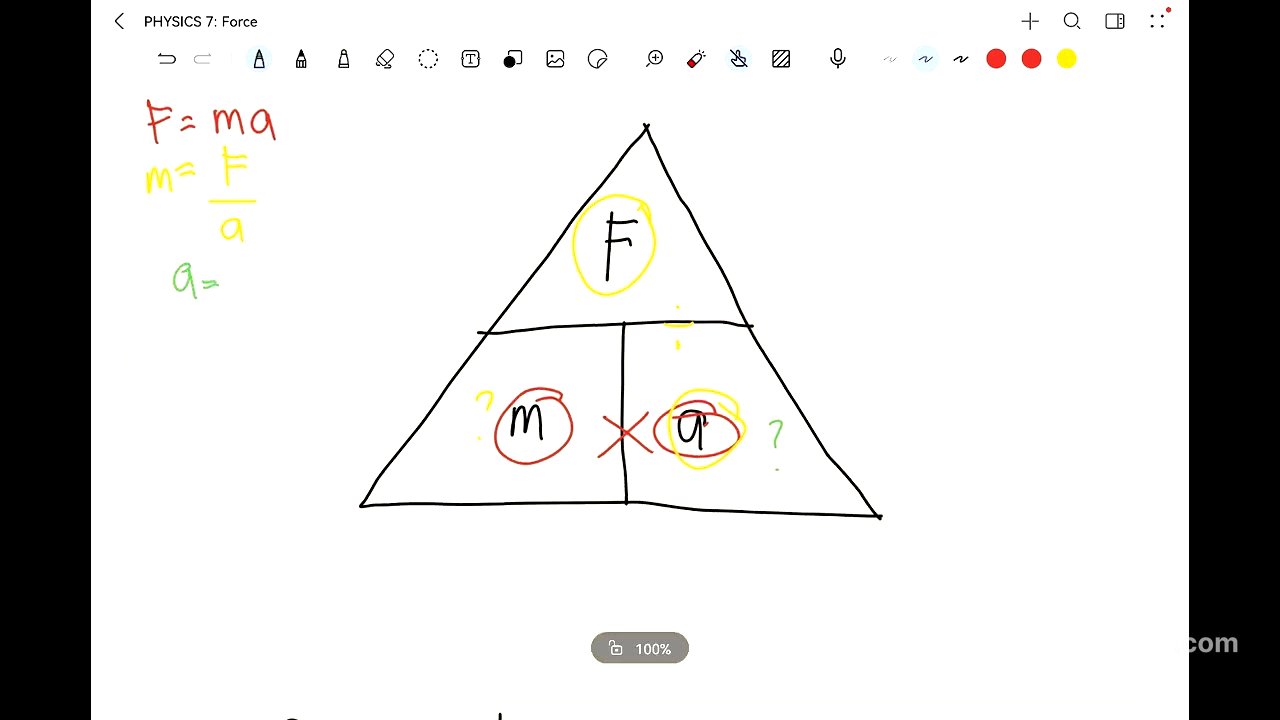
To solve for force, you multiply mass by acceleration (F = ma). To find mass, you divide force by acceleration (M = F/A), and to find acceleration, you divide force by mass (A = F/M). The video introduces a "magic triangle" as a visual aid to remember these formulas. The units are: Newtons (N) or kg⋅m/s² for force, kilograms (kg) for mass, and meters per second squared (m/s²) for acceleration. The "GFSA" method (Given, Ask, Formula, Solution, Answer) is recommended for solving problems in an organized manner.
Sample Problems Using GFSA Method [15:52]
The video demonstrates how to solve word problems related to force, mass, and acceleration using the GFSA method. Three sample problems are presented:
- Calculating force given mass (5 kg) and acceleration (2 m/s²), resulting in a force of 10 Newtons.
- Finding the force acting on a car with a mass of 1,200 kg accelerating at 1.5 m/s², which requires a force of 1,800 Newtons.
- Determining the acceleration of a 4 kg box when a force of 20 Newtons is applied, resulting in an acceleration of 5 m/s².
- Determining the mass of an object when a force of 15 N causes it to accelerate at 3 m/s², resulting in a mass of 5 kg.
Types of Forces: Contact vs. Non-Contact [34:30]
The video introduces the two main types of forces: contact and non-contact forces. Contact forces require physical touch for an object to move, such as opening a door, pushing a box, or holding a pencil. Examples of contact forces include friction, normal force, tension, applied force, and air resistance, which will be discussed in the next video. Non-contact forces, on the other hand, can cause movement without physical contact. Examples include gravitational force, magnetic force, static force, electromagnetic force, and nuclear force. These forces also will be discussed in the next video.



![FREE MOVIE [Survival Suspense Horror FULL Movies by 412A TV] full length movie](https://wm-img.halpindev.com/p-briefread_c-10_b-10/urlb/aHR0cDovL2ltZy55b3V0dWJlLmNvbS92aS9La3NjUzJyZ0kyVS9ocWRlZmF1bHQuanBn.jpg)