TLDR;
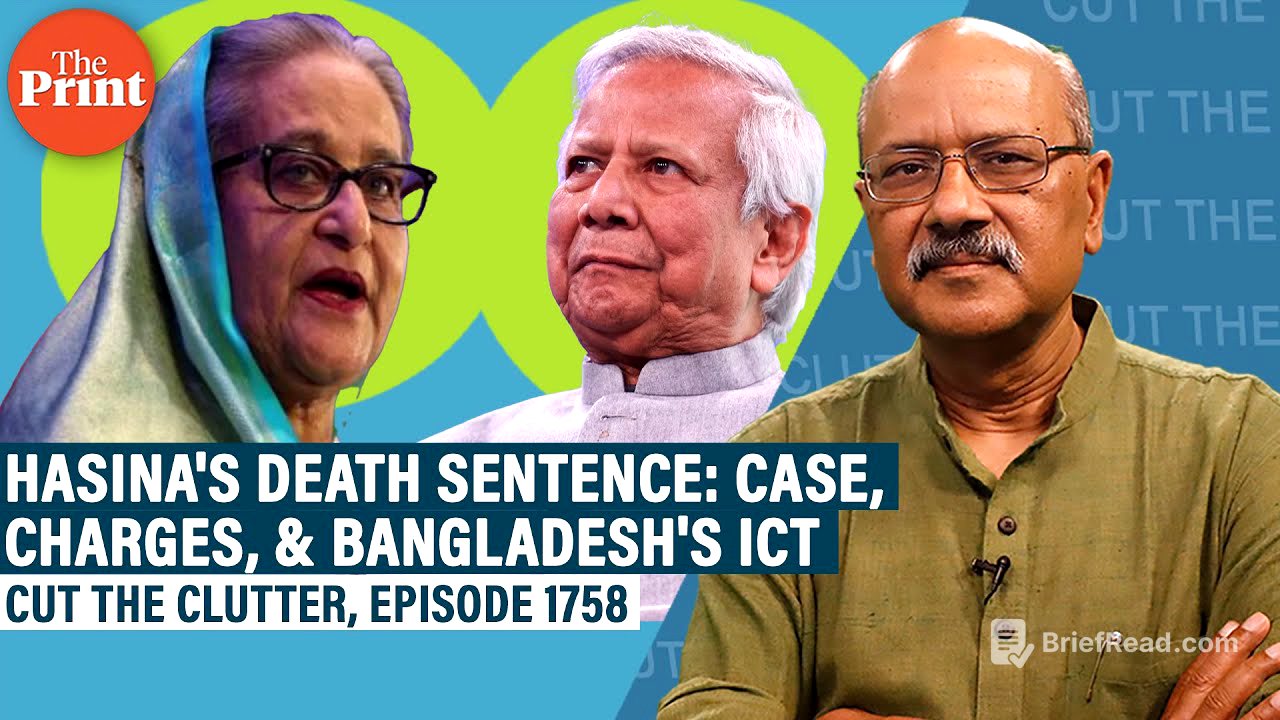
The video discusses the recent death sentence given to former Bangladeshi Prime Minister Sheikh Hasina by the International Crimes Tribunal (ICT) and its implications for upcoming elections. It explores the charges against her, the context of the ICT, and the potential impact on Bangladesh's political landscape and international relations, particularly with India. The video also touches on the role of social media in shaping public opinion and the concerns surrounding the credibility of the electoral process under the current unelected government.
- Death sentence for Sheikh Hasina raises questions about fairness and political motivation.
- Upcoming elections and the potential barring of Awami League could undermine legitimacy.
- India's cautious stance reflects the importance of its relationship with Bangladesh.
- Social media plays a significant role in shaping public opinion and election credibility.
- The current leader, Muhammad Yunus, faces a test of statesmanship in ensuring fair elections.
Introduction [0:10]
The International Crimes Tribunal (ICT) in Dhaka has sentenced former Prime Minister Sheikh Hasina to death for crimes against humanity and ordering the firing on protesters, resulting in numerous deaths and injuries. The charges stem from incidents involving police firings and attacks by Awami League supporters, with a large charge sheet detailing the accusations. Former IGP Ashraful Huda has also been convicted but received a reduced sentence for providing evidence against Sheikh Hasina and her Home Minister Asadu Zaman Khan.
The Trial and Verdict [3:24]
The trial was conducted in absentia, with Sheikh Hasina and others in exile, defended by a government-appointed council. The 8,747-page charge sheet included details of 1,400 people killed and 15,000 injured, with 54 witnesses examined over 28 days. The prosecution was led by senior government lawyers, while the defense claimed innocence. The verdict was swift, resembling a military court, and resulted in a death sentence. Initially, the ICT had no provision for appeal, but this was later added due to protests.
Sheikh Hasina's Response and Political Context [5:57]
Sheikh Hasina has denounced the tribunal as rigged and the order as issued by an unelected government without a democratic mandate. She accuses the interim government of attempting to remove her and nullify the Awami League as a political force. This verdict is seen as a move to secure her conviction before announcing election dates, with the aim of barring Awami League from contesting, similar to tactics used in Pakistan's elections.
India's Cautious Approach and Regional Implications [8:14]
India is treading carefully due to its important relationship with Bangladesh, particularly the settled borders and maritime agreements achieved under Sheikh Hasina. Despite Bangladesh's request for India to hand her back, India is unlikely to do so, especially with Bangladesh's National Security Advisor visiting for the Colombo Security Conclave. India's official statement is diplomatic, emphasizing peace, democracy, inclusion, and stability in Bangladesh.
The Charges and Tribunal's History [10:39]
The charges against Sheikh Hasina include murder, torture, and inciting violence against civilians. Specific cases include the murder of student Abu Sadat Beum and the killing of protesters in Dhaka neighborhoods. The tribunal, established by Sheikh Hasina, initially had no appeal system but later added one. It has handed out numerous verdicts, mostly in absentia, highlighting the potential for precedents to backfire.
Muhammad Yunus's Dilemma and International Pressure [15:26]
With the verdict delivered, Muhammad Yunus is expected to announce election dates but faces the decision of whether to allow Awami League to contest. Barring them could undermine the election's credibility, causing anxiety even among his international supporters, particularly in the US. Supporters like John Danilovitz have expressed concern over the delay and poor communication from the Yunus administration, which is damaging the democratic process.
Social Media and Election Credibility [18:23]
Awami League is running a potent social media campaign with the slogan "no vote," questioning the value of elections without their participation. Danilovitz is worried about this propaganda and urges Yunus to counter it to maintain the credibility of the electoral process. He quotes Yunus's commitment to delivering an election with high voter turnout and global confidence, emphasizing the importance of public participation for the legitimacy of the next government.
The Test of Statesmanship [21:16]
Muhammad Yunus is at a critical juncture, facing the temptation to hold onto power after enjoying global recognition and making significant policy shifts. The upcoming elections will test whether he is willing to relinquish power and ensure a fair election, providing an opportunity for global statesmanship. Until now, his actions have appeared driven by vengeance and a shift in Bangladesh's relationship with India.