
TLDR;
The global auto industry's shift to electric vehicles (EVs) is facing significant challenges, with governments and CEOs reassessing their strategies due to lower-than-expected consumer demand and economic realities. The transition, once seen as inevitable, is now a patchwork of regional markets heavily influenced by subsidies. Western consumers are skeptical of EVs due to higher costs, faster depreciation, and refueling inconveniences. Automakers are experiencing financial losses, scaling back EV production, and exploring hybrid solutions. China dominates the battery supply chain, posing a challenge to Western manufacturers.
- EV sales are slowing down in the West, while China's subsidized market is booming.
- Automakers are facing financial losses and scaling back EV production.
- The transition to EVs is heavily reliant on government subsidies.
- China dominates the battery supply chain, posing a challenge to Western manufacturers.
- The future of the auto industry will be decided by compliance officers navigating complex regulations.
The Electric Vehicle Revolution Stalls [0:00]
Three years ago, traditional carmakers were overly optimistic about transitioning to electric vehicles (EVs), influenced by Tesla's high valuation. Companies like Volkswagen, Stellantis, and General Motors made ambitious promises regarding EV sales and production. However, these promises are proving difficult to keep due to changing economic conditions and consumer behavior.
Reality Check: Subsides and Regulations [0:45]
The EV market faced a reality check when Donald Trump withdrew consumer tax credits and rolled back emissions regulations in the US. Similarly, the European Commission diluted its ban on combustion-engine cars due to pressure from auto manufacturers. The assumption that building EVs would automatically attract buyers has proven incorrect, with the revolution now driven by subsidies.
Consumer Resistance and Depreciation [3:01]
Consumers are resistant to purchasing EVs due to higher costs, faster depreciation, and inconvenient refueling. The industry is realizing that the transition to electrification was priced for perfection, but the customer experience has been lacking. Electric vehicles depreciate quickly, resembling iPhones more than classic cars, making them a risky financial investment.
Financial Losses and Reliability Concerns [5:57]
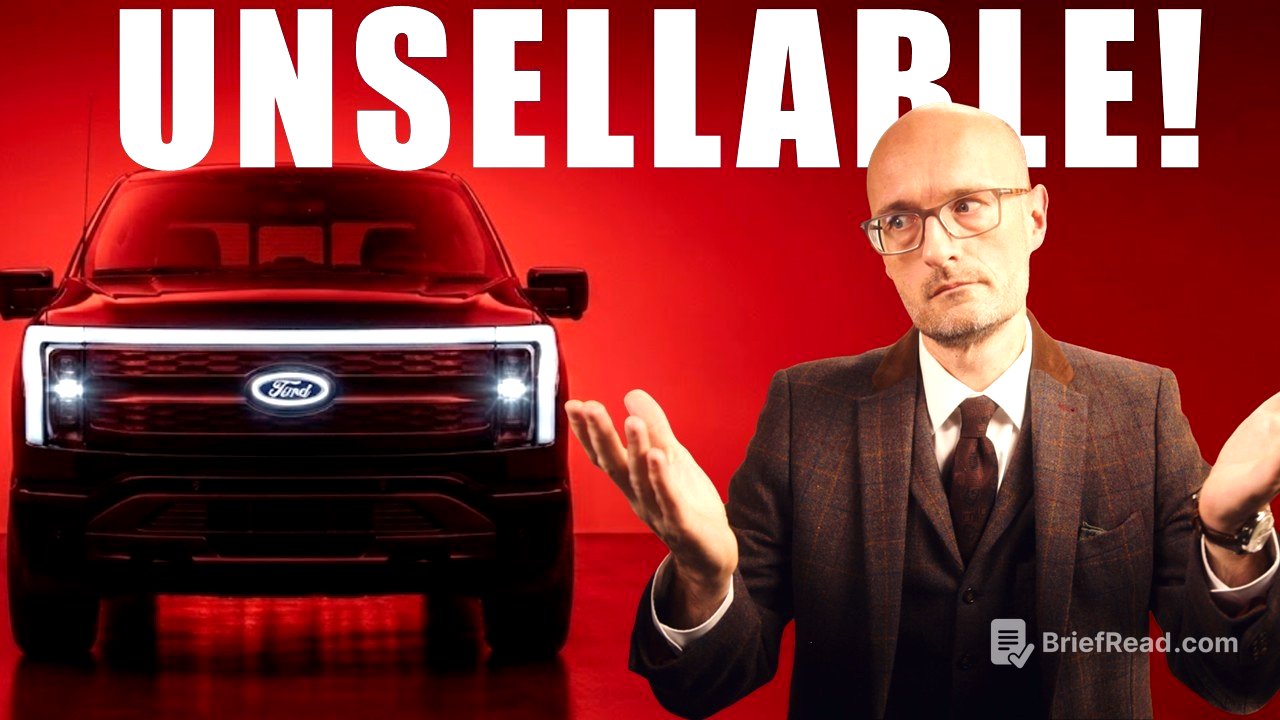
The financial pain extends beyond the initial price, with long-term reliability fears compounding the issue. Consumer Reports ranked Tesla as the least reliable used car brand in America. Hertz, the rental giant, removed 20,000 EVs from their fleet due to high repair costs and low customer interest. Ford announced a $19.5 billion write-down, scaling back its all-electric F-150 pickup plans due to collapsing sales.
Capitulations and Shifting Narratives [7:25]
Traditional automakers are capitulating, realizing that without massive subsidies, the "truck of the future" is not desirable to most consumers. Even Elon Musk has shifted Tesla's focus from selling cars to developing humanoid robots and "Full Self-Driving" software. This shift distracts investors from the reality that Tesla is selling fewer cars.
The Cost of Size and Engineering Contradictions [9:42]
Ford's electric vehicle division, "Model e," has been losing billions of dollars. Electrification inverts the logic that bigger vehicles yield higher margins. Electric pickup trucks require massive batteries, eroding payload capacity and efficiency. Detroit is pivoting to "Extended Range Electric Vehicles" with small internal combustion engines to recharge the battery, acknowledging the limitations of battery-only solutions for large vehicles.
Economic Realities and Government Handouts [12:29]
Manufacturers are losing money on almost every EV, and consumers are reluctant to buy them. Automakers lose around $6,000 on every EV sold in America. Demand for EVs is not organic but purchased through government handouts. The stop-start nature of subsidies makes industrial planning impossible.
The Early Adopter Phase and Mainstream Skepticism [15:18]
The industry has been selling to a niche demographic of wealthy, tech-obsessed early adopters who are forgiving of EVs' shortcomings. The mainstream buyer is pragmatic, cost-conscious, and unforgiving of inconvenience. They see EVs as a downgrade due to high costs, long refueling times, and range limitations.
Europe's Regulatory Minefield and Carbon Credits [17:39]
Europe's transition to EVs appears successful on the surface, but emissions targets and penalties have forced automakers to buy "carbon credits" from competitors like Tesla and Volvo. This subsidizes foreign companies and weakens the European balance sheet. Brussels is redefining the 2035 ban by allowing combustion-engine cars with offsets, turning them into luxury goods.
Compromises and Dangerous Games [20:55]
The compromise pleases no one but saves face, transforming industrial directives into a maze of loopholes. The European auto sector is politically too big to fail but commercially too weak to survive the current rules. Governments are betting the industry will adapt, while the industry bets Brussels will back down.
China's Dominance and Trump's Influence [22:22]
China controls 85 percent of global lithium-ion cell manufacturing capacity, creating a structural monopoly. Western governments are trying to wall off their markets with tariffs, but Chinese manufacturers are building factories inside Europe and Mexico. Donald Trump's policies have accelerated the EV war in Europe by allowing Detroit to build gas trucks again.
Strategic Errors and Realignment with Reality [25:21]
Western automakers are likely realigning with reality by pivoting from building cars regulators wanted to building cars customers want. The events of late 2025 mark the end of the "inevitability" narrative. The industry tried to force a technological transition overnight with subsidies and bans, but the experiment is stalling.
Economic Challenges and the Future of EVs [27:03]
Consumers are feeling squeezed by rising car prices. The average EV still commands a premium that mainstream buyers are rejecting. The cost of fuel and competition from Big Tech in the energy market pose looming threats to the EV industry. The transition to Net Zero has been indefinitely rescheduled, with plug-in car sales expected to plunge.