TLDR;
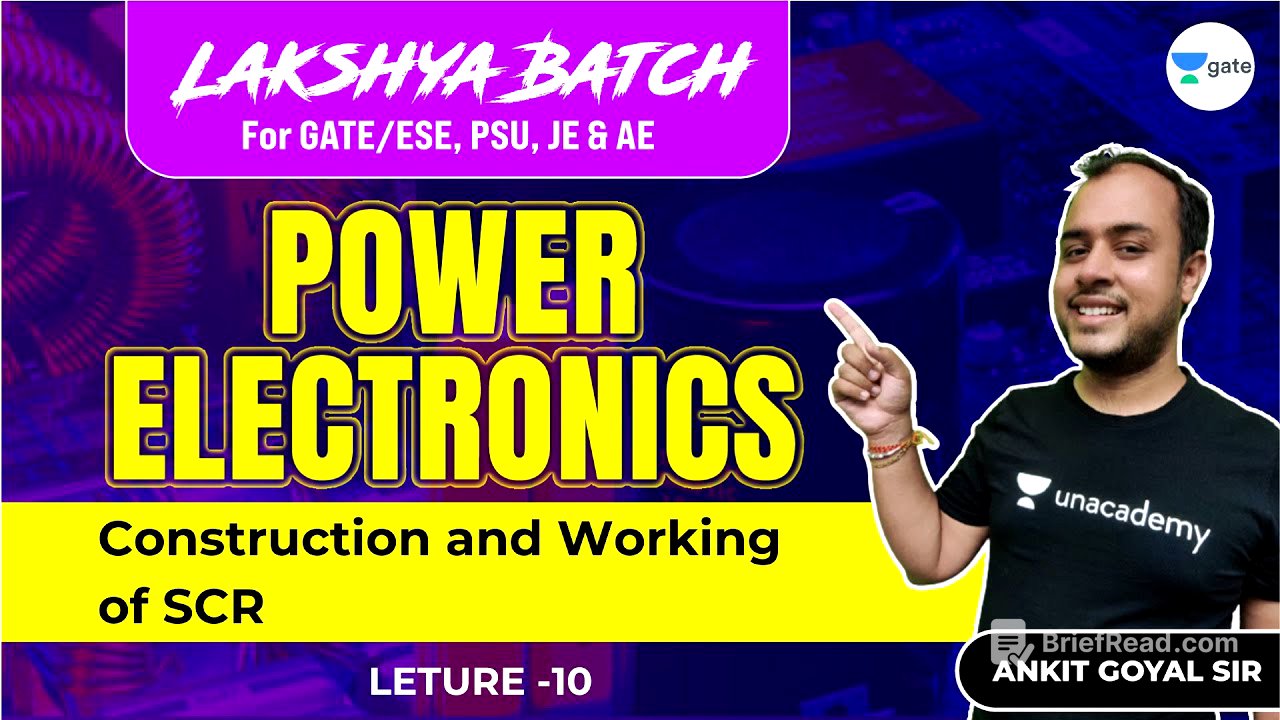
Alright guys, in this lecture, we're diving deep into the construction and working of the SCR (Silicon Controlled Rectifier), which is like, the baap of all devices in power electronics. We'll cover the symbol, layers, junctions, and how it behaves under different conditions. Plus, we'll see how it's related to diodes and transistors, and why it's so important.
- SCR is a four-layer, three-terminal device.
- It can be visualized as two BJTs connected together.
- It has three PN junctions, making it a minority carrier device.
- It has the lowest on-state resistance among semiconductor devices.
Introduction to the Session [1:14]
Good evening everyone! Today, we are starting a new chapter on power electronics, focusing on the construction and working of the SCR. This is the most important device in power electronics, and we will be studying it in great detail. The goal is to understand every aspect of it thoroughly.
About the Educator and Unacademy [1:55]
The educator, Ankit Goyal, talks about his background and the Unacademy platform. He encourages students to share the channel so that everyone can benefit from the knowledge. Unacademy offers live classes from top educators, comprehensive syllabus coverage, crash courses, daily assignments, weekly tests, doubt solving, and question banks. There are also iconic subscriptions with personal coaches, study planners, personalized guidance, test analysis, and dedicated teams for answering questions. Using the code ANKITG10 gives a 10% discount and personal guidance.
Announcements and Upcoming Batches [4:29]
The latest batch, Arjun, started on June 9th. A comprehensive machine batch is starting in July with a large number of problems. Join soon using the code ANKITG10. There's a Combat on June 13th at 11:00 AM; enroll using the code ANKITG10 to showcase your skills and win scholarships. The prices are going to increase soon, so join now. Education loan facilities are also available.
SCR Basics: Symbol and Construction [7:01]
Let's start with the basics of SCR. The symbol is similar to a diode but with a gate terminal. It's a three-terminal device with an anode, cathode, and gate. The SCR has four layers: P-N-P-N. There are three terminals but four layers because a depletion layer is added. The anode and cathode are lightly doped, while the gate is moderately doped.
BJT Analogy and Key Properties [9:03]
The SCR can be visualized as two BJTs (Bipolar Junction Transistors) connected together: a PNP and an NPN. This is why the terminals are named base and emitter. The SCR is a minority carrier device due to the PN junctions. More PN junctions mean more diffusion and recombination time, leading to a lower switching frequency. However, it also means more conductivity modulation and lower on-state resistance.
Construction Details and Material Properties [12:32]
The anode is a highly doped region, while the gate is moderately doped. The gate layer is lightly doped. The SCR can be visualized as two transistors connected together. It is a minority carrier device with three PN junctions. More conductivity modulation leads to lower on-state resistance. Minimum resistance results in maximum current rating.
PN Junctions and Their Importance [19:04]
The SCR has three PN junctions: J1, J2, and J3. The state of these junctions determines the SCR's operating region. The anode is highly doped, resulting in a low depletion width. The cathode is also highly doped, resulting in a low depletion width. However, the depletion width at J2 is high due to the lightly doped layers on both sides.
Depletion Width and Breakdown Voltage [21:41]
J2 has the highest depletion width because it is lightly doped on both sides. This results in a higher breakdown voltage for J2. The breakdown voltage is highest for junction J2 because of the light doping on both sides.
SCR Current Flow and Characteristics [22:55]
The current in an SCR flows from the anode to the cathode, similar to a diode. In the forward blocking region, the SCR blocks the voltage, and only a small leakage current flows. At a certain voltage, the SCR breaks down and enters the forward conduction state, where the voltage drop is very low.
Forward and Reverse Characteristics [25:54]
The SCR can block both forward and reverse voltages up to a certain limit. The forward breakover voltage is the maximum forward voltage the SCR can block before it starts conducting. The gate current helps in turning on the SCR at a lower voltage.
Reverse Blocking Mode [30:30]
In the reverse blocking mode, the anode is connected to the negative terminal, and the cathode is connected to the positive terminal. The outer junctions (J1 and J3) are reverse biased, while the inner junction (J2) is forward biased. The reverse voltage is handled by J1 and J3.
Depletion Layers in Reverse Blocking Mode [38:24]
In reverse blocking mode, depletion layers form at junctions J1 and J3, preventing the flow of majority carriers. This is why the SCR does not conduct in the reverse blocking mode. Depletion layers at J1 and J3 do not allow the flow of majority carriers, hence no current flows.
Forward Blocking Mode [41:26]
In the forward blocking mode, the anode is connected to the positive terminal, and the cathode is connected to the negative terminal. The outer junctions (J1 and J3) are forward biased, while the inner junction (J2) is reverse biased. The entire forward voltage appears across junction J2.
Forward Blocking Capability and Leakage Current [45:42]
The forward blocking capability depends on junction J2. The breakdown voltage of J2 is high due to light doping. The forward breakover voltage of the SCR is generally more than the reverse breakdown voltage. A small leakage current flows due to the minority carriers in the reverse-biased junction J2.
Transistor Analogy and Forward Conduction [51:28]
Thinking of the SCR as two transistors, neither transistor can turn on because the base is open. When the forward voltage is greater than the forward breakover voltage, junction J2 breaks down, and a flood of charge carriers flows.
Conductivity Modulation and Negative Resistance [56:57]
When a large number of charge carriers flow through the device, conductivity modulation takes place in the N- region, rapidly reducing the on-state resistance. This leads to a negative resistance characteristic, similar to what is seen in diodes.
Significance of Gate Current [1:03:36]
Applying a voltage between the gate and cathode forward biases the gate-cathode junction, allowing majority carriers to flow. Electrons enter the gate region from the cathode and combine with holes. The electric field sweeps most of the electrons into the N- region.
Regenerative Process and Latching Current [1:10:52]
To compensate for the lost electrons, the battery between the anode and cathode supplies holes to the anode region. Some holes recombine with electrons, but the rest are swept into the gate. These holes act as gate current, initiating a regenerative process (positive feedback system). Once the anode current rises above the latching current, this regenerative process can continue even without gate current.
Impact of Gate Current on Breakover Voltage [1:16:30]
As the gate current increases, more charges are available in the device. Due to more charges present in the device, the breakdown voltage is reduced. The forward breakover voltage of the device reduces as the gate current increases.
Junction States in Different Modes [1:21:16]
In forward blocking, the outer junctions are forward biased, and the inner junction is reverse biased. In reverse blocking, the outer junctions are reverse biased, and the inner junction is forward biased. In forward conduction, all three junctions are forward biased.
SCR Turn-On and BJT Analogy [1:23:58]
An SCR is considered to be on when both BJTs inside are in saturation region, such that all three junctions are forward biased.
MCQ Discussion [1:25:41]
The educator discusses multiple-choice questions related to SCR characteristics and advantages.
Announcements and Closing Remarks [1:30:29]
The educator shares links to special classes and encourages students to join the Combat on June 13th. He also announces the start date of a new batch and provides details about fees and subscription plans. He encourages students to like, share, subscribe, and comment on the video.